

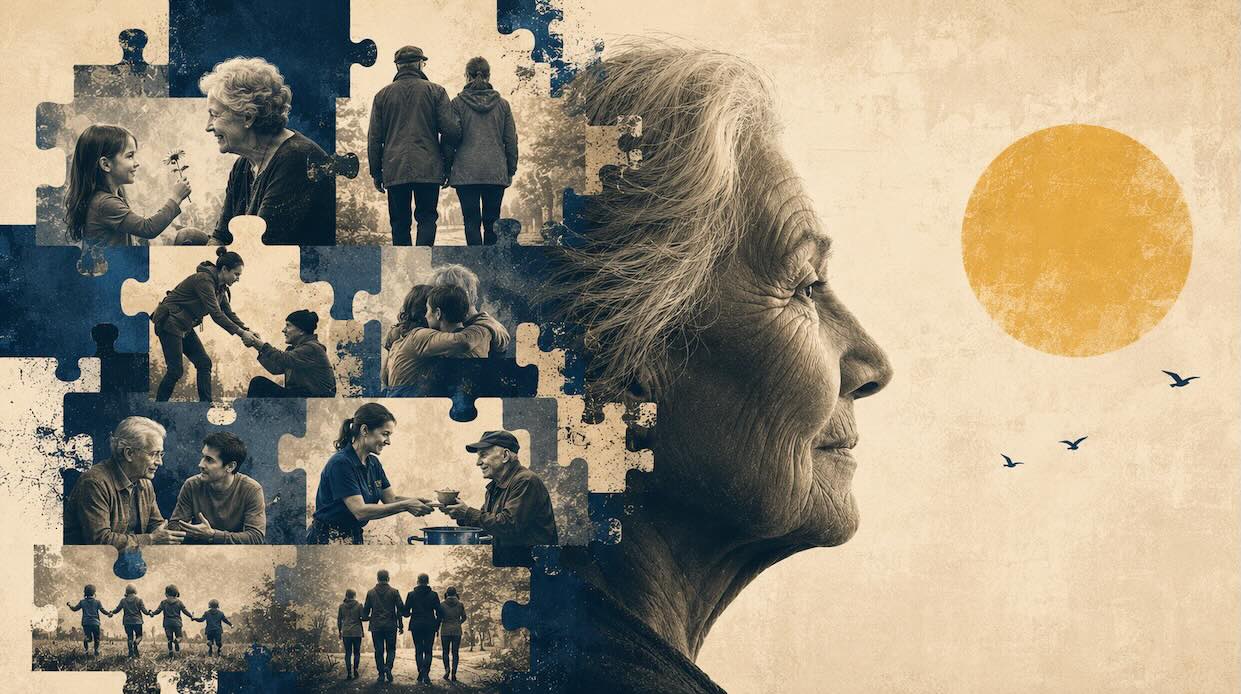
Before he died, Indianapolis businessman Terry Kahn gave his attorney one unusual instruction: Do not spend money on an obituary. Kahn did not believe anyone would be interested in reading about his life.
He was wrong.
When Kahn died in 2021, he left behind an estate worth nearly $13 million. He had lived modestly, driven older cars, and drawn little attention. Almost all of his fortune went to charities throughout central Indiana, supporting organizations devoted to children, older adults, education, the arts, and public health.
Newspapers across the country wrote about him anyway—not because he died wealthy, but because he died generous.
We admire achievement. We remember character. Success can be measured in salaries, promotions, awards, and possessions. Patience, compassion, humility, loyalty, and generosity resist measurement, yet they are often the qualities people mention first when remembering someone they loved.
That distinction lies at the heart of a remarkable study published this year by researchers who analyzed nearly 38 million obituaries. Spanning almost three decades and more than 6.7 billion words, the study asked a simple question: When a life is distilled into a few hundred words, what do families and communities choose to preserve?
The researchers were not measuring causes of death or charting demographic trends. They wanted to understand which qualities appeared most often when people described a life worth remembering.
The findings were striking. Again and again, obituaries emphasized devotion to family, generosity, compassion, service, faithfulness, love, and concern for others. Careers and accomplishments appeared, but they seldom dominated. What endured were the qualities that had made other lives better.
The researchers described obituaries as cultural time capsules, records of what people understand to be a life well lived. They set out to study memory. What they also uncovered were the values people hope will outlast them.
Obituaries are never complete accounts. They leave out impatience, failures, grudges, regrets, and the ordinary flaws that belong to every human life. Love edits the record. Families choose the stories that best express who a person was and what that life meant to others.
That selectivity is not a weakness. It may be an obituary’s greatest strength. It reveals what people believe is worth carrying forward.
The study answered one important question. It also raised another. If generosity, compassion, faithfulness, patience, and service are the qualities people cherish most at the end of a life, where do those qualities come from?
No one reaches adulthood with an unlimited supply of patience. Deep forgiveness rarely comes from a lecture. Compassion is not earned through a promotion, and humility is seldom the reward of success.
These qualities are shaped over years of living. They are tested while caring for children and aging parents, surviving disappointment, repairing relationships, sitting beside hospital beds, losing friends, asking forgiveness, and discovering that other people carry burdens we cannot see.
The passing years do not make anyone wiser or kinder. Time can harden as easily as it can enlarge. But a long life offers repeated opportunities to become someone different from the person we once were.
That possibility is one of the most encouraging findings to emerge from the modern study of aging.
Yale psychologist Becca Levy has spent much of her career studying the beliefs people hold about growing older. Her research shows that those beliefs matter. People with more positive views of aging often experience better health, stronger cognitive performance, and greater longevity than those who see later life through the lens of decline.
Levy does not argue that optimism prevents disease or reverses the passage of time. Aging remains a biological reality, and no attitude can erase its hardships. Her work demonstrates something else. The stories we tell about aging help shape the way we experience it.
If we expect later life to be little more than the steady loss of ability, we begin measuring everything that has diminished. We keep score through subtraction: less strength, less speed, less independence, less memory.
That scorecard is not wrong. It is simply incomplete. It overlooks some of the qualities that matter most.
Should patience receive as much attention as blood pressure? Should empathy matter as much as endurance? Should generosity become part of how we define healthy aging alongside mobility, memory, and physical independence?
Those are no longer merely philosophical questions. They are questions researchers are beginning to answer.
Several decades ago, Stanford psychologist Laura Carstensen challenged one of the central assumptions of aging research. The prevailing view held that emotional well-being declined alongside physical health. Older adults experienced more illness, more loss, and a greater awareness of mortality. It seemed reasonable to conclude that emotional health would decline as well.
The evidence told a different story.
Carstensen found that many older adults managed their emotions more effectively than younger adults. They often experienced fewer emotional extremes, recovered more quickly from disappointment, and became more selective about where they invested their emotional energy.
Her work became known as Socioemotional Selectivity Theory. As people grow more aware that time is finite, their priorities change. Emotionally meaningful relationships and experiences become more important, while status, novelty, and endless possibility lose some of their appeal.
Many older readers will recognize the pattern without knowing the name of the theory. Family dinners matter more than business dinners. A conversation with an old friend is more satisfying than impressing a room full of strangers. Arguments that once consumed an evening no longer seem worth beginning.
This does not mean people become passive or stop caring about achievement. It means they see more clearly the difference between what is urgent and what is important.
The desire to be right gives way to the desire to understand. Winning becomes less satisfying than reconciliation. Recognition matters less than connection.
Experience has a way of reordering priorities. After enough years, most people have seen victories forgotten within weeks and acts of kindness remembered for decades. They have watched careers end, possessions change hands, and old arguments lose whatever importance they once seemed to hold.
Success still matters. Responsibility still matters. Work still matters. They are no longer the only measures by which a life is judged.
A different question begins to emerge: not, “How far can I get?” but, “Who am I becoming?”
The answer is not found in age alone. The passing years can deepen patience, but they can also deepen resentment. Loss can enlarge empathy or drive someone to withdraw from the world. A long life gives us experience. It does not decide what we will do with it.
That distinction becomes critical when we consider suffering. No honest account of aging can ignore illness, grief, disappointment, caregiving, estrangement, financial strain, or the loss of people who once seemed inseparable from our lives. Yet suffering is not noble in itself, and pain carries no promise of wisdom. Some wounds remain wounds.
Psychologists Richard Tedeschi and Lawrence Calhoun began studying this difficult territory after hearing people who had experienced trauma describe changes they had not expected. Some reported a greater appreciation for life, closer relationships, new possibilities, increased personal strength, and spiritual growth. Tedeschi and Calhoun eventually called the phenomenon post-traumatic growth. The phrase referred not to the trauma itself, but to the growth that may occur as a person struggles to live with what happened.
That distinction cannot be stressed too strongly. Cancer is not a gift. The death of a spouse is not a lesson assigned for our benefit. Betrayal does not become good because we eventually learn from it. Even researchers in this field caution that reported growth can be difficult to measure and that people may experience distress and growth at the same time.
The honest claim is more modest. Adversity can sometimes alter a person’s understanding of what matters, especially when it is met with reflection, support, and a willingness to remain engaged with life. Suffering is never the benefit. The benefit, when there is one, lies in what a person is able to make from an experience no one would have chosen.
Older people have usually had more encounters with human vulnerability. They have made mistakes they once thought only other people made. They have needed help after years of providing it. They have watched strong people become frail and confident people become frightened. They have learned that someone can behave badly during the worst week of his life and that a polished appearance may conceal a burden no one else suspects.
Such knowledge can make judgment less satisfying. It becomes harder to divide the world neatly between the capable and the incapable, the fortunate and the unfortunate, the people who made good choices and those who did not. Experience complicates those categories. A person who has needed mercy may become more willing to extend it, and someone who has known helplessness may notice it sooner in another.
This does not mean older adults spend their days in perfect emotional balance. Age does not eliminate vanity, anger, fear, or selfishness. It does, however, provide repeated evidence that human beings are less self-sufficient than they once imagined. For those willing to accept that evidence, humility becomes less an ideal than a realistic assessment of the human condition.
What the Research Shows
Research into aging, adversity, and adult development does not support the claim that people automatically become kinder as they grow older. It does identify several ways in which later life can encourage emotional and moral growth.
- Our view of aging matters. Becca Levy’s research has linked more positive beliefs about aging with better physical and cognitive outcomes and greater longevity.
- Priorities often become more selective. Laura Carstensen’s work shows that awareness of limited time can increase attention to emotionally meaningful people and experiences.
- Growth after hardship is possible, not inevitable. Richard Tedeschi and Lawrence Calhoun found that some people report stronger relationships, greater appreciation of life, new possibilities, and changed priorities after struggling with trauma.
- Contribution can become a central purpose of adulthood. Erik Erikson used the term generativity to describe the desire to guide, support, and invest in those who will follow us.
Generativity may be one of the clearest answers to the question posed by the obituary study. As people move through adulthood, many become less concerned with proving their own importance and more concerned with making themselves useful. They teach, mentor, care for grandchildren, preserve family stories, volunteer, support community institutions, and help younger people avoid mistakes they once made themselves.
After retiring from a 26-year career teaching kindergarten, Sara Bealer did not decide that her usefulness had ended. She began volunteering with Meals on Wheels and continued for 20 years. The food mattered, but her role extended beyond leaving a meal at the door. She formed relationships with the people on her route, watched for signs of illness or loneliness, and became a regular human connection for older adults who might otherwise see few people during the day.
Bealer’s story is not dramatic, and that is part of its value. She did not create a foundation or make a large public gift. She took the attentiveness developed during a lifetime of caring for young children and carried it into another chapter. The recipients changed, but her concern for another person did not.
Erikson described generativity largely as a desire to establish and guide the next generation, but the impulse can reach in many directions. It includes anyone who begins asking how accumulated knowledge, time, patience, or money might serve lives beyond one’s own. It is present when a retired carpenter repairs a community center, when an older neighbor checks on a family during a crisis, and when someone who has endured grief sits with a newly bereaved friend without offering easy answers.
The obituary researchers found that benevolence, family devotion, tradition, and concern for others appeared repeatedly in the way millions of lives were remembered. Those values do not usually emerge from one magnificent act. They are built through conduct repeated often enough to become character.
That is why Terry Kahn’s story carries more weight than the amount he left behind. His $13 million made the news, but generosity was not created at the moment his estate was settled. The final gift reflected decisions made over many years: to live with restraint, to avoid display, and to direct what he had accumulated toward people he would never meet.
The same principle operates on a smaller scale in most lives. Character is established in how we respond when someone takes too long, needs more than we expected to give, disappoints us again, or asks for forgiveness before we feel ready to offer it. These choices rarely seem important enough to become part of anyone’s obituary while they are happening. Taken together, they become the life.
Aging therefore presents more than a series of losses to manage. It also brings an expanding body of experience from which compassion, patience, humility, and generosity may be drawn. We have seen more, survived more, regretted more, forgiven more, and depended upon more people than we once expected. None of that guarantees growth, but it gives us material with which to work.
The researchers who examined nearly 38 million obituaries were not claiming to produce complete or candid biographies. Obituaries favor affection. They leave out old arguments, failures of nerve, selfish decisions, strained relationships, and the contradictions present in every person. The dead are usually granted a generosity in print that they may not always have received in life.
We recognize that convention, and still we read obituaries. Their selectivity does not deprive them of meaning. By choosing what to praise, families reveal what they hope will endure. An obituary is less a final audit than a statement of values: these were the qualities that mattered, these were the acts worth remembering, and this is what a life gave to the people who remain.
Every obituary therefore points in two directions. It honors the person who has died, but it also reminds those who remain what they hope will matter when their own story is told. Achievement may earn a line, but kindness earns a story. Status may explain what someone did, while character explains why that person is missed.
We spend much of our younger years trying to make a life through work, family, plans, responsibilities, and ambitions. Later life gives us a chance to ask what that life is making of us and what qualities we still have time to strengthen. The years behind us cannot be rewritten, but the story is not finished while there are still people to encourage, injuries to forgive, burdens to share, and opportunities to be useful.
Terry Kahn did not believe anyone would be interested in reading about his life. He underestimated what people would find worth telling. They were not drawn to his story because he had accumulated $13 million. They were drawn to what he chose to do with it and to the generosity that choice revealed.
Someday, each of our lives may also be reduced to a few hundred words. The question is not whether those words will describe a flawless person; they will not. Nor is it whether they will list enough achievements to impress a stranger. The more important question is whether someone will want to tell the stories that explain who we became and why our presence mattered.
Those stories are still being written. We have a voice in what they will say through the patience we offer, the burdens we help carry, the forgiveness we extend, and the uses we find for the years that remain.
Related spiritual themes: aging well, awareness, belonging, discernment, ego and aging, emotional wisdom, inner life, legacy
Reader submissions may be lightly edited for clarity and length, while preserving the writer’s original voice.

John Williams July 17, 2026
This is a very interesting article, not only for its content, but because I have recently retired. I am still finding the new me, the retired me. This is also complicated because I am recovering from some mental health issues and I am discovering my new norm at the same time I am figuring out what the retired John thinks and does. A few observations I took from the article are: “A long life offers repeated opportunities to become someone different from the person we once were.” This really strikes close to home, here I am discovering my new norm as well as what the retired John looks like. What do I really like and want to do? I am discovering they are very different then what they were. What I have come to understand is that it is my decision to make. How do I want to help, who do I want to help, and it is OK for me to change my mind. Another interesting point is Sociemotional Selectivity Theory – a lifespan theory of motivation which states that, as time horizons grow shorter, people’s goals shift such that those with more time prioritize future-oriented goals and those with less time prioritize present-oriented goals. [“What Is Socioemotional Selectivity Theory?” By Cynthia Vinney] This is a very interesting theory and deserves more research, but even though I am only 59, I still feel the crunch of time. My final observation is “A long life gives us experience. It does not decide what we do with it.” which I believe requires some more contemplation on my part to truly understand what these few words are really saying. What we do with our experience is really up to us, we can use it to make ourselves better and others better at the same time. I have five kids and I would think they could all gain some level of life lessons from my experiences. It really boils down to how I present my experience to them. I could be all high and mighty or humble, I believe the latter would be accepted more readily and believe that is the way I will head. Thanks for your time and great article.