
“Yo! Adrian!”
It is one of the most memorable lines in modern cinema. It sounds like a victory cry, which makes it easy to forget that it is shouted at a moment of defeat.
Rocky Balboa has just gone fifteen rounds with Apollo Creed, his face battered and one eye nearly swollen shut. The ring is filling with reporters and handlers, the crowd is roaring, and somewhere amid the confusion the judges are announcing that Creed has won by split decision.
Rocky barely hears them. He is searching the crowd for Adrian, who is struggling toward the ring as he calls her name. By the time she reaches him and they fall into each other’s arms, the championship that has occupied the entire movie has become almost beside the point. Rocky has lost the fight, but he has found the person he needs at the moment when all the fighting is over.
Sylvester Stallone was 30 years old when Rocky reached theaters in 1976, close enough to his fictional fighter that the boundary between creator and character was never very firm. Stallone knew something about being dismissed and something about needing to prove people wrong. He had struggled for years as an actor before writing the screenplay that changed his life, and when Rocky became a phenomenon, Hollywood gave him nearly everything it had withheld. The film won Best Picture, while Stallone was nominated for Academy Awards for both his performance and his screenplay.
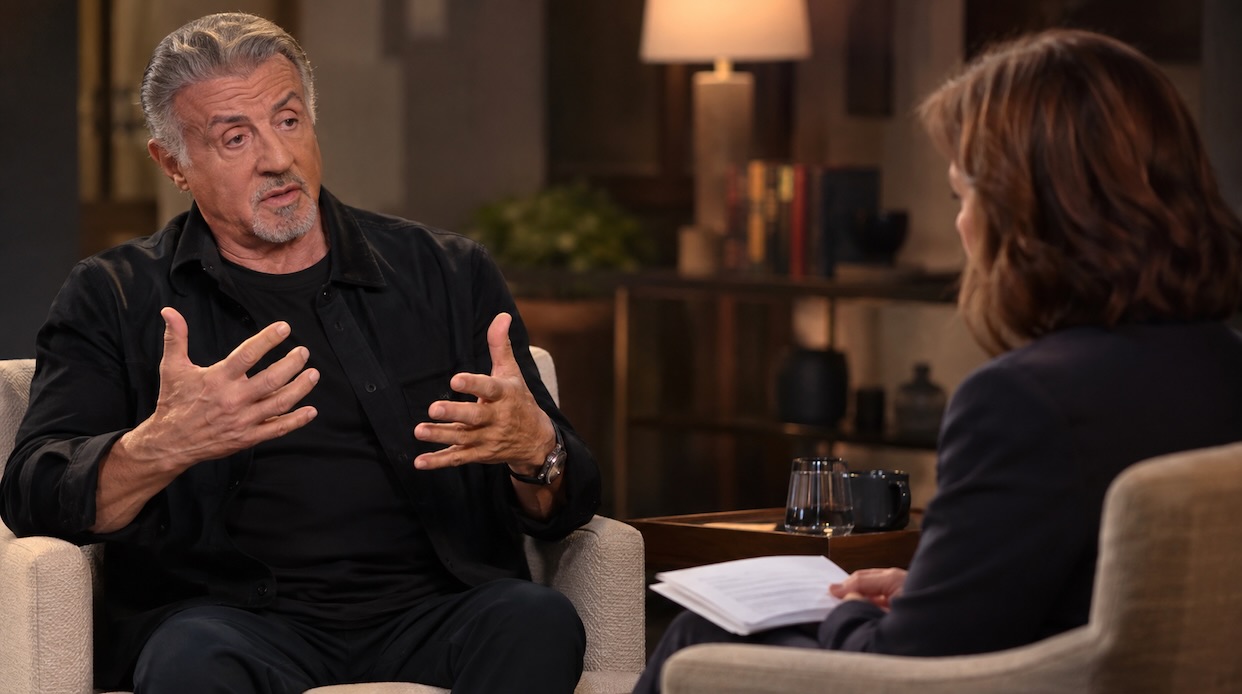
Half a century later, Stallone is 80, and he has been thinking about what all that proving cost him. In a recent interview with Lulu Garcia-Navarro of The New York Times, conducted around the publication of his memoir, The Steps, he talks about the body he once regarded as his “armor,” the childhood that made such protection seem necessary, and the regrets that accumulated while he was busy becoming one of the most recognizable men in the world.

The armor came early. Stallone describes parents who provided little affection and a childhood in which violence was common enough that he learned to expect it. When he was very young, his parents sent him to live in a boardinghouse, where he was largely raised by strangers. After they separated, he lived with his father, whose anger could turn physical with little warning.
One memory is especially hard to hear. A cat was crying outside the house. Stallone says his father brought it inside, took it to the laundry room, shot it and left it in the washtub. Stallone believes his father was trying to demonstrate something about toughness to his son.
Garcia-Navarro stops him at that word. Stallone has repeatedly described his father as tough, but that isn’t what she hears in the story. Stallone considers the distinction and agrees. He had been using toughness, he says, as a masculine label for something much darker.
Yet children do not necessarily stop wanting love from parents who hurt them, and this may be the part of Stallone’s story that matters most.
When the impossible finally happened and Rocky went into production, Stallone gave his father a small role as the timekeeper during the climactic fight between Rocky and Apollo Creed. Everything was riding on the movie. Stallone was an unknown actor who had fought to play the lead in his own screenplay, and now he had invited into the middle of his great chance the man who had frightened and humiliated him as a boy.
Garcia-Navarro asks why.
Stallone’s answer is not about duty or reconciliation. He wanted his father to love him for a little while. He wanted to show him what he had accomplished and have his father share it with him. After all the years in which his father had regarded him as a fool, Stallone still wanted what children have always wanted: I see you. I am proud of you.
Instead, his father repeatedly missed the carefully choreographed moment when he was supposed to ring the bell, leaving Stallone and Carl Weathers continuing a fight that should have ended. Stallone became angry, his father answered with anger of his own, and another confrontation followed. Stallone had hoped his father would finally be proud of him. Once again, he was disappointed.
His mother could still reach the same vulnerable place. When Rocky was nominated for Academy Awards, Stallone invited her to the ceremony. Ten months earlier, he says, he had been nearly homeless. Now the movie he had written was competing for the highest honors in Hollywood, and he wanted his mother beside him. She refused to go.
Nearly half a century later, he is still talking about that night. Stallone describes the hurt as a scar that never fully closes, one that can begin hurting again when he least expects it. The world could applaud him, the Academy could honor his movie, and audiences could turn him into an international star, but none of it could supply what two particular people had withheld.
Nor did becoming Sylvester Stallone finally settle things with his father. Years later, when Stallone was in his forties and his father was 68, they were driving along Sunset Boulevard when an argument returned to the beatings Stallone had endured as a boy. Stallone said he wished they could be the same age for three minutes so his father could experience some of his own medicine. His father pulled the car over, removed his jacket and challenged him to fight right there.
By then the son was one of the most famous action stars in the world. Millions of people had watched Rocky Balboa and John Rambo survive punishment that would destroy almost anyone else. Sitting beside his father, Stallone could still be brought back to the boy who had learned that strength meant never allowing himself to be broken.
Many of us will recognize a quieter version of this story. We can outlive our parents by thirty or forty years and still carry the child who wanted something from them that never came. Age may help us understand our parents better. We may learn what wounded them, recognize the limitations they carried from their own childhoods, and sometimes forgive what they did with those wounds. But understanding is not the same as becoming untouched.
A criticism at 70 can awaken something first felt at ten. The need to prove ourselves may survive long after there is anyone left to impress. Someone who learned early that depending on other people was dangerous may discover decades later that accepting help feels like more than an inconvenience. It threatens an identity built around never needing anyone.
Stallone could become rich, famous and physically formidable, and neither success nor age could make him invulnerable to his parents. The more protection he built, the more revealing it becomes to discover the boy still living underneath it.
Eventually, the armor became visible.
The Stallone of the first Rocky was fit, but he did not yet have the sculpted physique that would later become part of his identity. As the Rocky films continued and John Rambo became another cultural phenomenon, Stallone’s body changed along with the characters he played. He became leaner, more muscular and more imposing until physical power was no longer simply something his characters possessed. It became part of what audiences expected when Sylvester Stallone appeared on a screen.
By Rocky III, the pursuit had become extreme. Stallone says he drove his body fat down to 2.6 percent, developed bulimia and used steroids as he tried to maintain the physique he believed the role required. What audiences saw as extraordinary discipline had become, by his own description, an obsession.
The consequences accumulated over decades of punishing training and doing his own stunts. At 80, Stallone says he has undergone nine back operations, two shoulder operations and three neck fusions. He still exercises and wants to remain fit, but when Garcia-Navarro asks whether he continues to regard his body as armor, his answer is no. Maintaining it, he says, came at a “terrible price.”
He had already discovered, briefly, what it felt like to take some of that armor off. In Cop Land, released in 1997, he played Freddy Heflin, an overweight, partially deaf New Jersey sheriff surrounded by men more powerful than he was. After years of being expected to look like the strongest man in the room, Stallone deliberately played what he calls the weakest. He remembers the experience as liberating.
Liberation did not mean transformation. Cop Land did not redirect his career in the way he hoped, and Stallone returned to the roles audiences expected from him. Like most of us, he did not abandon an old way of living simply because he had glimpsed an alternative.
He can also look back at Rambo, the traumatized Vietnam veteran of First Blood, and see how the wounded man gradually disappeared beneath the weapons and spectacle of the sequels. Stallone accepts responsibility for that transformation. It became easier to make Rambo physically indestructible than to keep exploring what had damaged him.
“Flexing your muscles is a lot easier than showing your soul,” he says.
At 80, Stallone is showing considerably more of his.
Watch: Sylvester Stallone at 80
In this conversation with The New York Times’ Lulu Garcia-Navarro, Stallone talks about the childhood that shaped him, the physical and emotional armor he built, and what he sees differently now.
What emerges from the interview is not the satisfying story of an older man who has finally figured everything out. Stallone makes no such claim. He can see connections that were invisible when he was younger and name some of the damage more clearly, but insight has not rewritten the past.
“I can make a castle out of regrets,” he says.
Some of those regrets concern his own children. Stallone acknowledges that he was not the father he wishes he had been, particularly during his first marriage, when ambition consumed him. He describes himself then as being in “warrior mode,” determined to conquer the world while people who needed him sometimes came second.
The symmetry is uncomfortable. The boy who grew up wanting more from his parents became a father whose own children sometimes needed more from him. We do not automatically become the opposite of the people who hurt us. Without intending to, we can carry what we learned into relationships with people we love.
Then came a loss for which reflection could offer no repair. Stallone’s eldest son, Sage, died in 2012 at 36 from coronary artery disease. Stallone remembers the questions that followed: What could he have done? Should he have been there? Might some different choice have changed what happened?
Grief can take love and turn it backward, asking us to solve a past that can no longer be changed.
Stallone’s regrets reach beyond fatherhood. He says he did not understand what he considers genuine, wholehearted love until he was about 70. He had spent much of his life competing, proving, building, protecting and trying not to become what he feared the world thought he was. Those instincts helped carry him from obscurity to a career few actors ever experience, but he can now see what they sometimes crowded out.
Amid his memories of his own father, however, Stallone carries one that is entirely different.
He was about nine years old. His father had him take care of the horses but would not allow him to ride them, and one day they were driving home from the barn when the boy fell asleep. His father placed his son’s head on his knee and stroked his hair.
For a child accustomed to hardness, the gesture was so unfamiliar that Stallone remembers recognizing, for perhaps the first time, what tenderness felt like. At 80, he can still summon that brief touch from a father he otherwise remembers for anger and violence.
The memory survived alongside everything else.
That tells us something about what we carry into later life. We remember the wounds, but we may also remember the scraps of love with extraordinary precision: a hand on the head, a rare word of praise, the afternoon a distracted parent unexpectedly listened, the one time someone usually distant drew close. When affection was scarce, even a small measure of it could become unforgettable.
Later life does not give us another childhood, nor does it guarantee that we will finally make peace with the one we had. Stallone is candid about that. Asked whether he has forgiven his parents, he describes what he has reached as a kind of delicate peace treaty. There is little point, he says, in walking around yelling at ghosts.
Acceptance does not require us to pretend that nothing happened. It means recognizing that some arguments can no longer be won.
Many people reach later life still conducting old trials in their heads. We imagine the conversation in which a parent finally understands. We replay the injustice with a better closing argument. We continue proving that we became successful, decent or strong despite what someone once predicted about us. The parent may have been gone for years, but the case remains open.
Growing older gives us an opportunity to notice when we are still living in response to a verdict handed down long ago. The independence that served us well may have begun as a refusal ever to be vulnerable again. The perfectionism that built a career may still be trying to earn approval that never arrived. Even our insistence on being strong for everyone else can become a way of making certain no one sees how much we sometimes need them.
None of this makes those strengths false. Stallone’s determination was real, as was the discipline that helped him endure rejection after rejection and create Rocky. What protected us when we were young may also have carried us a very long way. The question in later life is whether it still has to carry us in quite the same way.
Stallone knows there is less time available to answer that question. When Garcia-Navarro asks how he feels about death now that considerably more life lies behind him than ahead, he does not offer the serenity we sometimes expect from an 80-year-old looking back on an accomplished life. He says he is in “panic mode,” not because there are more awards to win, but because he worries that there is not enough time to make up for what he regrets. What remains, he says, needs to be concentrated on the people who need him and those whose lives will continue after his.
That is a striking destination for a man whose public image was built around self-sufficiency. The young Stallone survived by becoming harder. The older Stallone talks about love, family, regret and loneliness. He warns against allowing ourselves to become isolated and insists that age does not put us beyond love.
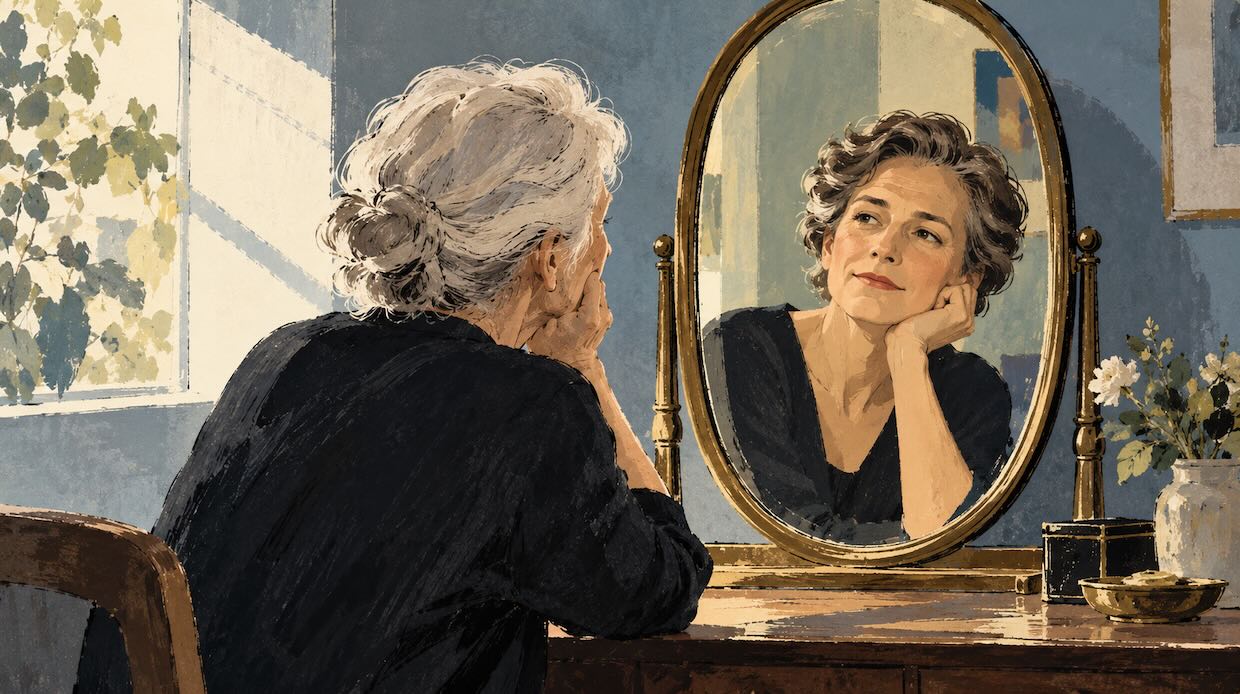
Last Sunday, we considered the distance that sometimes exists between the age on our birth certificates and the age we experience inside ourselves. Stallone’s story suggests another reason that distance can be complicated. We do not carry only the younger adult who fell in love, raised children, built a career or made mistakes. Somewhere within all those accumulated years may also be the child who decided what the world was like before he was old enough to question the lesson.
We do not need to blame that child, but neither must we let the child continue making every decision.
At 80, Stallone can look at the toughness that helped him survive and ask what was underneath it. He can acknowledge the cost of the armor without denying that it protected him. He can regret the love he withheld while recognizing the love still available to him. None of that changes his childhood, restores his son, repairs his body or gives him back the years he wishes he had lived differently.
It does give him the years he has left.
And it brings us back to Philadelphia and something Sylvester Stallone wrote when he was only 30.
For nearly two hours, Rocky appears to be moving toward one question: Can Rocky Balboa go the distance with Apollo Creed? Rocky already knows he probably cannot beat him. What matters is whether he can still be standing when the fight is over.
The bell rings after the fifteenth round, and Rocky has accomplished the thing he needed to prove. The judges can decide who won the fight. For once, their verdict does not matter very much to him.
The ring fills with people as reporters push microphones toward his face and the decision is announced. Apollo Creed has won, but Rocky is looking somewhere else. The character who has spent the entire movie learning whether he is strong enough to stand on his own begins calling for the person he loves.
Maybe the young Stallone understood more about strength than he knew.
Armor can help us survive the fight. It can help us endure what once seemed unbearable and carry us farther than anyone expected us to go. But when the fighting is finished, armor cannot give us what we were protecting all along.
Rocky doesn’t call for the belt.
He calls for Adrian.
“Yo! Adrian!”
Related spiritual themes: aging well, ego and aging, emotional wisdom, humility, impermanence, inner life, spiritual aging
Reader submissions may be lightly edited for clarity and length, while preserving the writer’s original voice.