

Forgive me at the outset. I like puns.
Years ago, my best friend’s mother would say they were the lowest form of humor. We disagreed. A good pun, if it holds, does more than play with words. It carries two meanings at once and lets them work on each other.
Which brings me, somehow inevitably, to Carl Jung.
I first began reading Jung at midlife. Not casually, and not without resistance. His work has a way of asking for more than attention. It asks for participation. And one of the things that becomes clear, over time, is that the parts of ourselves we would rather not examine are often the very places where the work needs to begin.
That realization doesn’t arrive in a study or a lecture. It shows up in ordinary moments—a reaction that feels disproportionate, a flash of jealousy, a wave of shame, a defensiveness that seems to rise before we have time to consider it.
Jung had a name for this: the complex.
And once you begin to recognize it, a question presents itself—not as theory, but as practice.
Am I, in this moment, Jung at heart?
To be Jung at heart is to recognize when something deeper is shaping our reactions and to stay with it rather than turning away. It is a practice of awareness, not a claim of mastery.
Where the Work Begins
What follows is not a system, and certainly not a cure. It is closer to a set of reminders—drawn from Jung’s work—that can help us stay with that question when it matters most.
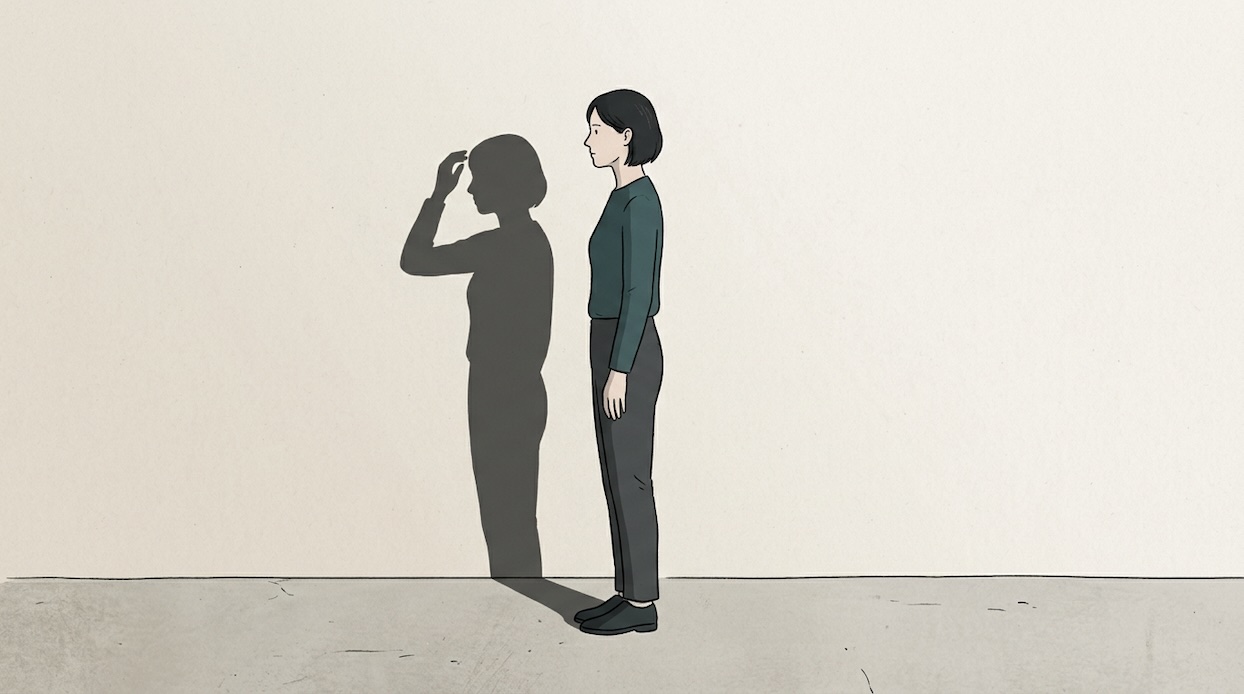
The work often begins with what Jung called the shadow.
Jung believed that each of us carries aspects of ourselves that we would prefer not to see. Not because they are rare or unusual, but because they do not fit the image we have built of who we are. We push them aside. We explain them away. We attribute them to others. And yet, they remain.
Often, they appear in the very qualities we find most difficult in other people—the trait that irritates, the behavior that provokes a strong reaction out of proportion to the moment. These are not proofs of moral superiority. They are signals—uncomfortable, but useful.
To be Jung at heart is to pause there, rather than move past it—not to condemn oneself, but to ask what part of this belongs to me.
What Surfaces
The complex is often what brings the shadow to the surface.
We like to think we are responding to the present moment. Often, we are not. A comment lands harder than it should. A situation feels strangely familiar. The emotional response is immediate and disproportionate. Something older has been stirred.
Jung’s insight was not simply that this happens, but that it can be observed—that we can begin to recognize when we are no longer fully in the present, when another layer has entered the room.
Again, the question is not what to do, but whether we notice.
Am I, right now, caught in something I have felt before?
What We Project
And what we do not recognize in ourselves does not disappear. It often reappears elsewhere. Jung called this projection.
What we are not yet able to hold within ourselves, we tend to locate outside. It feels cleaner that way, more manageable. But it comes at a cost. The world becomes populated with qualities we refuse to examine in ourselves.
To interrupt that pattern requires restraint—not silence, but a brief hesitation before judgment settles into certainty.
What if this, too, has something to do with me?
Becoming Whole
Individuation, in Jung’s work, is often misunderstood. It is not a process of becoming better in the usual sense. It is a process of becoming more complete.
That means holding tension rather than resolving it too quickly, allowing contradictory aspects of the self to exist without forcing them into coherence, and accepting that growth does not always feel like progress.
This runs against much of what we are taught. We prefer clarity. Resolution. A sense that we have moved beyond something. Jung suggests otherwise.
To be Jung at heart is to remain with the work even when it resists simplification.
What Grounds a Life
And beneath all of this is something more basic.
The ego—the part of us that manages identity and presentation—is not the whole of who we are. There is something deeper, less easily defined, that organizes a life over time. Jung called this the Self.
We do not control it. At best, we become more aware of it. Which means that not everything that unsettles us is a problem to be solved. Some things are invitations to pay attention.
That is not always welcome. It is not always comfortable. But it can be steadying. Because it suggests that even the moments we would prefer to avoid are not interruptions to a life. They are part of it.
Jung’s work does not promise ease. If anything, it suggests the opposite—that a life lived more consciously will, at times, feel more demanding, not less. But there is a different steadiness that comes with it: a sense that we are no longer entirely at the mercy of what arises within us. Not because we have eliminated it, but because we have begun to recognize it.
And that changes things.
Because, as the old song has it, “If you should survive to a hundred and five… look at all you’ll derive out of being alive” —if you are, in the moments that matter, Jung at heart.
—Jim
P.S. After my wife read this, she gave it a thumbs up and said, “Close the comments on this one. I don’t want them to encourage you.” (Comments are open, of course). If the piece resonates, you’ll know the moments—those times when something in you pauses and you think, almost in passing, “you make me feel so Jung.”
If you find value in these reflections, you can support Spiritual Seniors and help sustain the work:
Support the work
Related spiritual themes: emotional wisdom, inner life, jung, mindfulness in later life
Reader submissions may be lightly edited for clarity and length, while preserving the writer’s original voice.



Susan Stevens May 3, 2026
Wow! Jung hits home! I actually took notes on this article! Thnx for the share!
MARIE HADLEY May 3, 2026
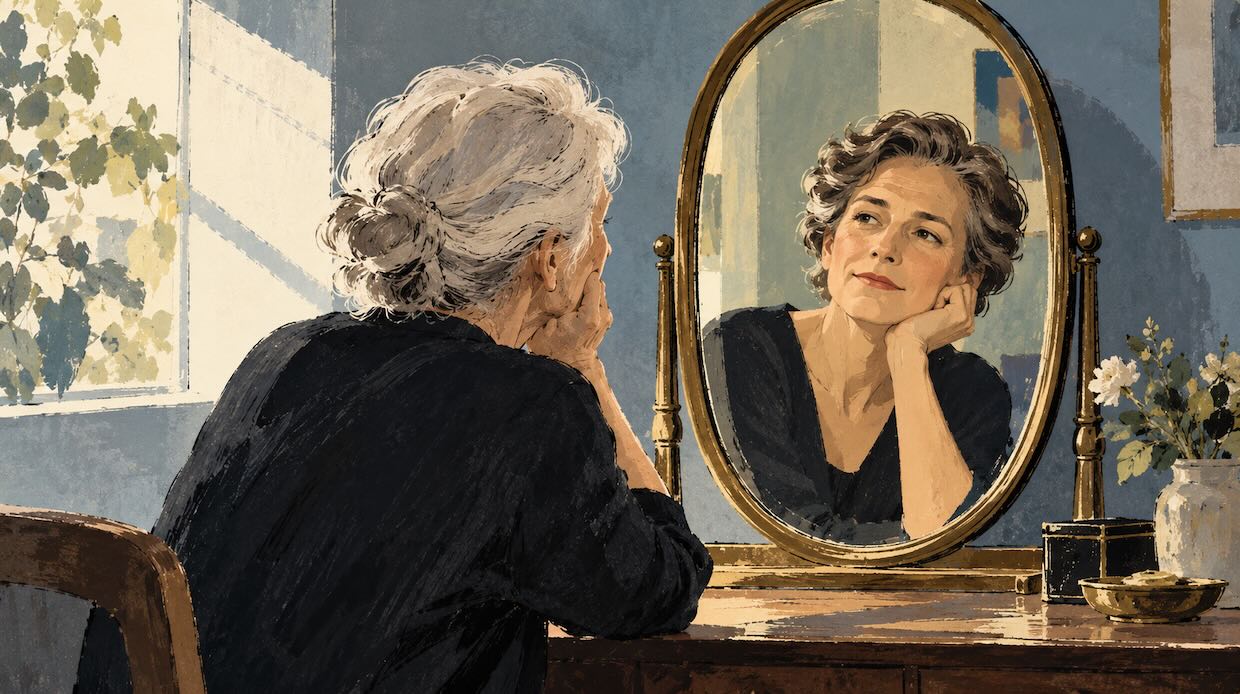
The mirror concept is a difficult one but oh so true. Staying in the discomfort and sometimes literally looking at myself in the mirror and asking what is present is enlightening. It’s so easy to see in other people but not so easy when it comes to me.
bev@sheppardwest.com May 3, 2026
I enjoyed the Jungian refresher – succinct and clear. The challenge for me is that despite having the ability to reflect on my reactivity and its darker shadow within me, I still often have knee jerk reactive responses having difficulty with the “pause” before the response. This is a lifelong process, obviously!
tracey@lovesuccs.me May 5, 2026
Love the puns! Jung at heart 💜🙌🏼
James Sarafin May 15, 2026
To live in the present moment we must shift our attention away from our thoughts to our perceptions of the present moment, thoughtlessly.
Thought, being a movement, draws our attention and where our attention is directed is what our consciousness is seeing so to be in the present moment we must have a silent mind so that our attention is directed toward our perceptions.
Only in the present, free of thought’s distractions. can we see who we are and how we work.