
Last week, we explored individuation—the inward movement toward wholeness that Carl Jung believed marks the second half of life. Jung was clear about one thing: this work cannot stay in our heads. It cannot remain a set of ideas we agree with. Sooner or later, it has to show up in how we live.
And that includes the body.
For many of us, that’s where things get hard. The body slows. It aches. Recovery takes longer. We are quietly encouraged to turn our attention elsewhere—into memory, into conversation, into safer forms of meaning—just as the body begins demanding more patience.
But what if the body is not an obstacle to spiritual life? What if it becomes one of its teachers?
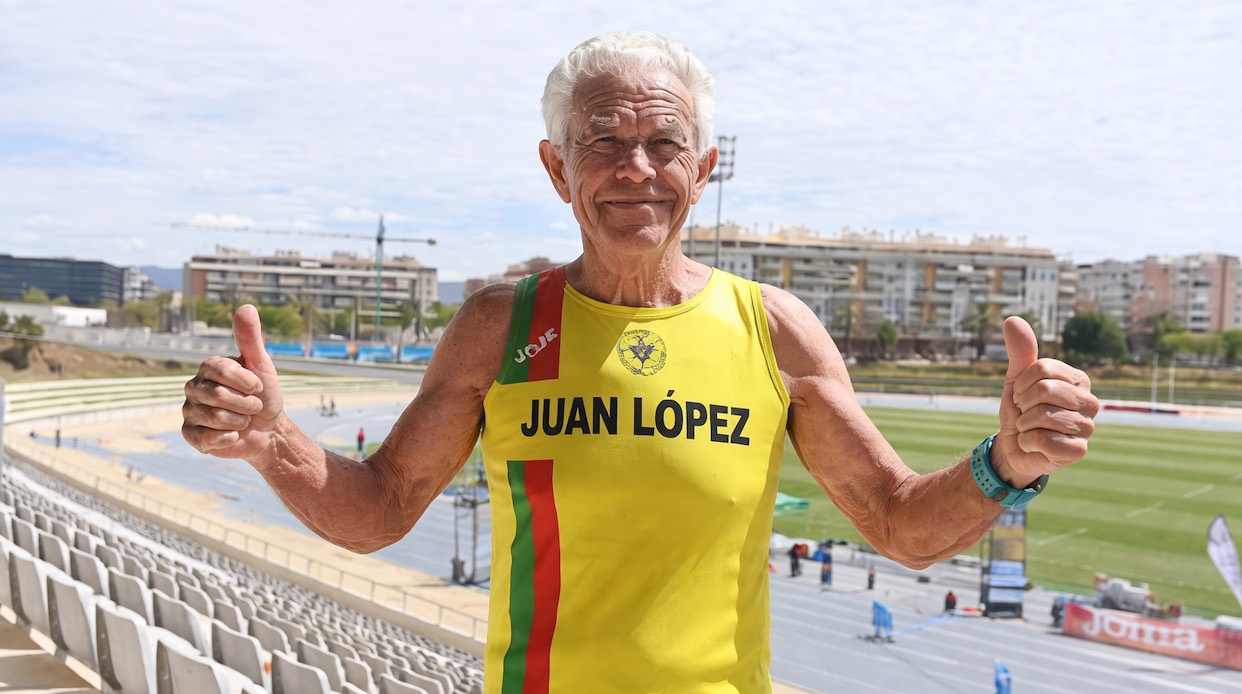
This is where the life of Juan López García becomes worth noticing.
At 82, López García holds world records in ultramarathon running. Researchers studying him have documented cardiovascular capacity and metabolic health more typical of someone decades younger. His endurance is real. His physiology is unusual.
But the real interest isn’t the numbers.
It’s the way he lives inside his body.
Who he is—and what he is not
It would be easy to turn López García into a headline: the octogenarian who outruns time. But that misses the quieter truth.
He isn’t reckless. He doesn’t talk about defying age. He doesn’t pretend the body doesn’t change. He adjusts.
Those who study him point out how moderate his routines are. He runs most days, but not to exhaustion. He trains below maximum effort. He pays attention to strain early. He rests when needed.
He is not fighting his body. He is staying with it.
Routine as a rule of life
There is something almost monastic about that rhythm. Not dramatic. Not performative. Just steady.
The same route. The same hour. The same return.
Research supports what this suggests. Long-term moderate aerobic activity is strongly associated with preserved cardiovascular health and emotional regulation. Consistency, not intensity, appears to matter most.
But the deeper point isn’t the science. It’s the habit.
Discipline here doesn’t look like control. It looks like attention. The choice to keep showing up to the body as it is today—not as it was, not as it “should” be.
For many seniors, that shift changes everything. Movement becomes less about proving something and more about remaining awake to one’s own life.
Endurance and the interior life
Anyone who has walked long distances knows something about this. After a while, the mind settles. Thoughts come and go without urgency. The body keeps moving.
Scientists explain this in terms of nervous system regulation and hormone levels. That is true. But repetition also changes a person.
Decades of steady endurance have shaped López García’s temperament. Researchers describe him as calm and grounded, without the frantic edge that often accompanies performance culture.
In spiritual language, we might call that steadiness. Not detachment. Not withdrawal. Just steadiness.
And steadiness becomes more valuable with age. Anxiety and isolation take a toll. Staying embodied—through walking, swimming, stretching, tending a garden—keeps a person rooted in something solid and real.
Aging as stewardship
Perhaps the most instructive element of López García’s life is how he responds to limits.
He does not deny them. He works within them.
Training adjusts. Rest expands. Signals of fatigue are taken seriously. Pain is neither dramatized nor ignored.
Gerontologists describe this flexibility as adaptive mastery—the ability to revise goals without collapsing identity. In plain language, it means you can change how you move without losing who you are.
Spiritually, this resembles stewardship. The body is no longer an instrument for proving something. It becomes something entrusted to your care.
That orientation matters biologically as well. Chronic stress leaves measurable marks on the body. Long habits of steadiness leave marks too.
What can actually be modeled
The point is not that anyone should run ultramarathons at 82.
The point is that staying in relationship with the body—at whatever level is possible—shapes the inner life.
Disciplined embodiment might look ordinary: a daily walk, slow laps in a pool, light stretching before bed. The scale does not matter.
What matters is that the body is not abandoned.
This is where López García’s life intersects quietly with the work of individuation. In the second half of life, the task shifts. It is no longer about expansion. It is about coherence.
The body, when treated with attention rather than frustration, becomes part of that coherence.
When body and soul meet
Juan López García’s life suggests that aging does not have to be framed as either decline or defiance.
It can be lived as rhythm.
As adjustment.
As steady return.
Not heroic.
Not optimized.
Simply inhabited.
Related spiritual themes: ego and aging, healing, movement, spiritual resilience, spiritual wellness
Reader submissions may be lightly edited for clarity and length, while preserving the writer’s original voice.