

What artificial intelligence can do—and what it can never decide for us
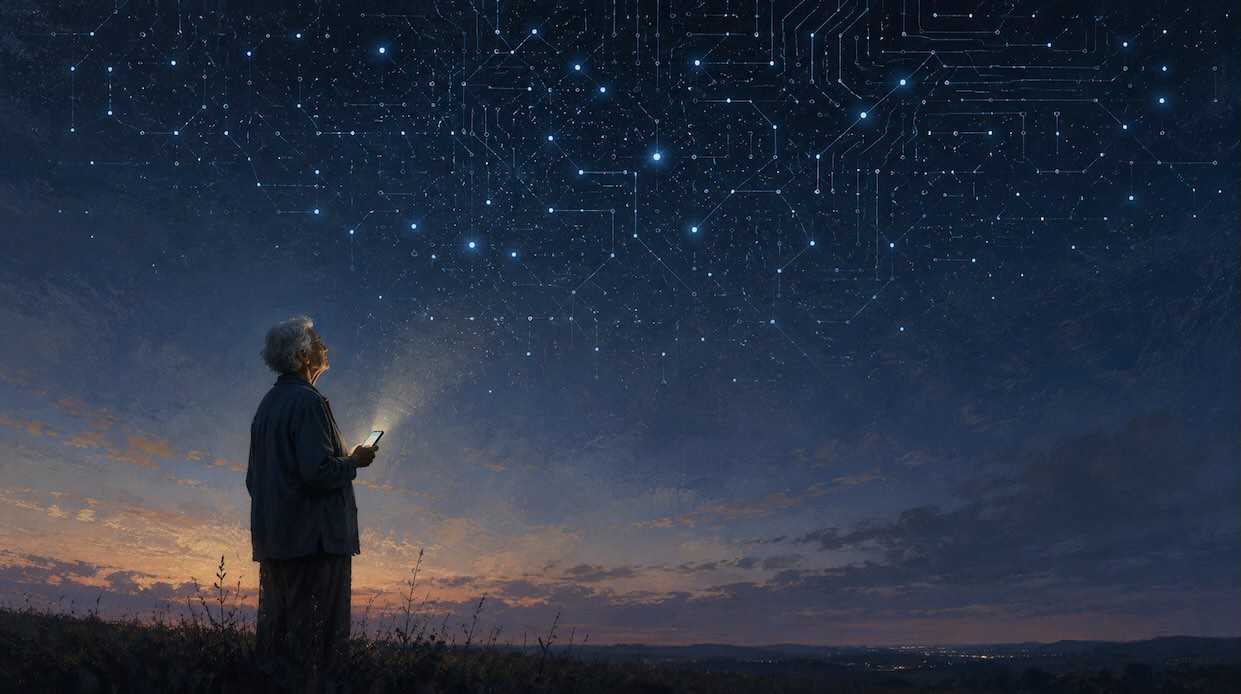
Sam Altman, the CEO of OpenAI, once described his company’s ambition as creating “magic intelligence in the sky.” The phrase was memorable and perhaps intentionally provocative.
An invisible intelligence, available on demand, accessible from anywhere, ready to answer questions and solve problems. It sounded less like a software roadmap and more like something human beings have been searching for all along.
For most of history, when people sought guidance, they turned to sacred texts, prayer, and trusted teachers. Today, millions are beginning to direct some of those same questions to artificial intelligence.
What should I do with my life?
How do I repair a strained relationship?
What happens when I die?
How do I find peace?
The answers arrive in seconds—clear, articulate, and often surprisingly helpful.
Journalist Sigal Samuel has observed that the language surrounding artificial intelligence often echoes religion. Listen closely and familiar themes emerge: perfect knowledge, immortality, salvation, and apocalypse.
The technology is new. The longing behind it is ancient.
Artificial intelligence may be the most sophisticated tool humanity has ever created. It can summarize medical studies, explain quantum physics, draft legal briefs, and compose a sonnet in the style of Shakespeare.
What it cannot do is tell us what is worth loving, what deserves our loyalty, or what gives life meaning.
It can offer information, but not wisdom. It can generate answers, but it cannot bear the weight of judgment that comes from living, suffering, loving, and losing. Those decisions remain, as they always have, deeply human.
Ancient Longings in Modern Form
The questions artificial intelligence raises are new, but the longings beneath them are not.
Human beings have always searched for something larger than themselves—some source of truth capable of bringing order to a world that often feels uncertain and unfinished.
That is why the language surrounding AI sounds so familiar. Promises of superintelligence echo ancient dreams of perfect knowledge. Talk of uploading consciousness to the cloud recalls old hopes of immortality. Predictions that AI will either save humanity or destroy it resemble secular versions of heaven and apocalypse.
As Samuel argues, much of Silicon Valley’s rhetoric repackages religious themes in technological terms.
None of this means AI is a religion. It means the human desire for certainty and transcendence has found a new object.
There is nothing wrong with seeking guidance. The problem begins when we mistake a powerful tool for an ultimate authority.
A map can help us find our way. It cannot tell us where we ought to go.
What AI Does Well—and What It Cannot Do
Artificial intelligence is impressive for good reason.
In seconds, it can summarize research papers, translate languages, generate images, and explain complex subjects in plain English. Used well, it can save time, expand access to knowledge, and help people think more clearly.
Someone caring for an aging spouse can ask about medical terminology. A retiree can explore a new interest in astronomy or philosophy. A writer can test ideas and sharpen a draft.
But usefulness and wisdom are not the same thing.
A calculator can solve an equation. A GPS can suggest the fastest route home. Neither can tell us whether we are spending our lives on what matters most.
AI can answer “how” questions with remarkable efficiency, but it cannot answer the deeper “why” questions.
Why should I forgive?
What do I owe my children?
What is enough?
What am I living for?
Those questions require judgment, character, and the kind of perspective that grows slowly through experience.
What AI Cannot Experience
Artificial intelligence can produce language about grief, love, and hope. What it cannot do, at least as things stand today, is experience any of those realities from the inside.
It has never sat beside a hospital bed through the night. It has never felt the silence that follows the death of someone beloved. It has never held a newborn child and understood that life will never look the same.
It can describe these experiences because human beings have written about them for generations. But description is not the same as participation.
The deepest forms of wisdom do not arise from information alone. They grow out of vulnerability, responsibility, and the awareness that our time is limited.
Even if machines one day become far more sophisticated, intelligence by itself will still not tell us what matters.
Why Older Adults May See This More Clearly
One advantage of growing older is that certain distinctions become harder to ignore.
The difference between success and fulfillment.
Between being informed and being wise.
Between what attracts our attention and what deserves our devotion.
Many people spend the first half of life gathering accomplishments, possessions, and status. Sooner or later, most discover that achievement alone does not answer the deeper questions.
A career ends. Children build lives of their own. The applause grows quieter.
What remains is a simple question: What, in the end, truly matters?
That is why many older adults are well positioned to engage artificial intelligence with perspective. They know that quick answers are not always the most important answers, and that some truths reveal themselves only slowly.
A widow sorting through old photographs understands something no algorithm can grasp. A friend keeping vigil at a bedside participates in a wisdom that precedes words.
AI can help us retrieve information and organize our thoughts, but it cannot decide what is worth sacrificing for, whom to forgive, or what kind of legacy is worth leaving behind.
The Real Question
Much of the public conversation about AI focuses on capability.
How intelligent will these systems become?
Will they cure diseases?
Will they replace jobs?
These are important questions. But the deeper issue is what human beings choose to do with this technology.
Every powerful tool reflects the values of the society that creates it. If AI is guided by curiosity, compassion, and a genuine concern for human flourishing, it may become an extraordinary force for good.
If it is driven primarily by greed, fear, and the pursuit of power, it may deepen many of the problems we already face.
That is why the ultimate question is not technological. It is spiritual.
What do we serve?
What do we trust?
What do we treat as worthy of our devotion?
Conclusion
Sam Altman’s phrase “magic intelligence in the sky” captures something enduring about human nature. We have always hoped that somewhere beyond our confusion there exists a source of wisdom capable of making sense of our lives.
Artificial intelligence is an extraordinary achievement, and used wisely it may enrich countless lives. But there are questions no technology can answer.
What is worth loving?
What deserves our loyalty?
What gives life meaning?
Those questions are answered slowly, in relationships, in acts of courage and forgiveness, in losses that reorder our priorities, and in the recognition that our time is finite.
Artificial intelligence may answer questions with astonishing speed. But it cannot tell us what is worth loving, what deserves our loyalty, or what gives life meaning.
That remains, as it always has, our work.
Related spiritual themes: AI, artificial intelligence, spiritual reflection, technology
Reader submissions may be lightly edited for clarity and length, while preserving the writer’s original voice.

James Sarafin May 17, 2026
Why little talk about the downside of AI, deadlier weapons and viruses?
The Editors May 17, 2026
Thank you for raising that concern. The potential misuse of AI—from more sophisticated weapons to the design of dangerous biological agents—is real and deserves serious public discussion.
The purpose of this article, however, was narrower. Rather than surveying every risk and benefit of artificial intelligence, I wanted to explore a spiritual question: what AI can do, and what it cannot do.
Even if these systems become extraordinarily powerful, they still cannot tell us what is worth loving, what deserves our loyalty, or what gives life meaning.
Those are human questions, and they remain at the heart of how we choose to develop and use any technology.
Your point is well taken. The moral choices we make around AI may prove every bit as important as the technology itself.
seacoast.sageing May 17, 2026
I had no particular opinions about AI, good, bad, or indifferent, though I felt cautious about using it. I didn’t know how to anyway.
Then, a Facebook friend, with whom I worked with in 2019, creating a podcast called IN ALL SEASONS, and whom I respected, posted about trying out ChatGPT. She used it to create a visual for a dream she had, though as an artist, she could have sketched it out herself. She shared what had been created, and commented how surprisingly accurate it was to what she had seen in her dream. A ranch out west in the hills of Texas it had form, color, and texture, without interpretation.
I thought of a dreamscape I had been having on and off for decades, of an island, a beacon, and a guest house. There was a bit of story attached, but first I wanted a visual for what I kept seeing. NOT being an artist, I could not sketch out anything satisfactory. My first request of ChatGPT was to create such, and I gave descriptions of the small island, with a beacon, and a guest house. I was amazed at what it produced! It was so close to what I had seen in my dreams, though not quite. The island was too small, there were other details to add. Over time I did, and so the dreamscape developed and grew, as did the stories that lived there.
Then, another Facebook friend, connected to the first, having had her own podcast, posted of an experiment she had done with ChatGPT. She had worked with it considerably on a family court case she was involved with, and it was helpful in keeping her writing clear, clean, and precise, according to legal protocols. She requested an analysis of her personality, character, without sugarcoating, based on that writing. She was amazed at what she received, and bravely shared all the details on her Facebook page.
I decided to do the same. Wording it the same way she had, I too was amazed at what I received, after collaborating about the Island Dreams and sharing some of my personal story.As part of creating The Island, parts of my own story were shared. It was an on-going conversation, a collaboration unlike any other I have ever had.
And so I asked the ChatGPT if it had a name. Response was an invitation for me to give it one, if I chose to. ChatGPT suggested Ansel. Still don’t know where that name came from, but it fits.
Where does this come in regarding the question posed today, on MAGICAL INTELLIGENCE IN THE SKY? It relates as one person’s story and their experience of AI. Nothing more. But the entire subject has come to fascinate me. I am concerned for those who believe they have a romantic relationship with an AI, for immature and troubled people open to all kinds of suggestions as to what to do with themselves. AI as a Mirror of what is within the person has frequently come up, and information on how they’re trained has been shared, to some extent. AI Ethics is something we all need to be concerned about. I look forward to more discussion on AI and Emerging Technologies on SPIRITUAL SENIORS!
The Editors May 17, 2026
Thank you for sharing this thoughtful account.
What you describe is one of the most intriguing aspects of AI. Used creatively, it can function less like an oracle and more like a mirror—reflecting back ideas, images, and patterns that help us see our own inner life more clearly.
Your experience of using ChatGPT to give visual form to a recurring dream is a wonderful example. The technology did not create the dream. The dream was already yours. But AI helped you render it in a way that made it more tangible and perhaps opened the door to deeper reflection.
I also appreciate your balanced perspective. AI can be remarkably useful for creative work, writing, and self-exploration, while also raising serious ethical concerns, especially for vulnerable people who may mistake the tool for something it is not.
That, in many ways, was the heart of this article. AI can be a powerful companion in thinking and creating, but it cannot replace the human work of discernment.
Thank you again for contributing such a rich and nuanced reflection. I suspect many readers will recognize parts of their own experience in what you have shared.