

There is a word in Finland that has no comfortable English translation.
Sisu (pronounced SEE-soo).
Courage comes close. So do grit, determination, endurance and perseverance. But each misses something. Sisu describes what happens when the difficulty before us seems greater than the strength we believe we have left.
The word has been part of Finnish culture for centuries, but it became inseparable from the country’s national identity during the Winter War of 1939–1940. Finland, with a population of fewer than four million people, faced an invasion by the Soviet Union, whose population was roughly forty times larger. The Finns were badly outnumbered and outgunned. They fought through one of the coldest winters in memory, sometimes in temperatures approaching 40 degrees below zero.
Finland eventually ceded territory, but remained independent. Sisu became one of the words used to explain how. Its meaning, however, reaches well beyond battlefields.
Psychologist Anu Realo, writing about sisu in 2023, described setting out for a Nordic walk on a February day in Helsinki. The temperature hovered around freezing, the wind cut through her clothing, and before long her fingers were numb. Turning back would have been understandable. She kept going.
That may sound like ordinary perseverance. Researchers studying sisu have found something more interesting.
Emilia Elisabet Lahti, a Finnish researcher who has devoted years to studying the concept, describes sisu as a form of inner strength that appears when people reach the limits of what they believe they can do. It is not the energy that gets us started. It is the reserve we draw upon when the energy we expected to have is gone.
More than a century before psychologists began trying to measure sisu, the American psychologist and philosopher William James was asking a remarkably similar question.
In a 1907 essay called “The Energies of Men,” James considered the familiar experience of reaching what feels like exhaustion, only to discover that necessity sometimes carries us beyond it. Athletes know the phenomenon as a second wind. James believed it revealed something important about human capacity.
“It is evident that our organism has stored-up reserves of energy that are ordinarily not called upon, but that may be called upon,” he wrote.
Most people who have lived long enough know something about those reserves.
They may have appeared during months spent caring for someone who could no longer care for himself. They may have been there after the telephone call that divided life into before and after. They may have carried someone through financial loss, the end of a marriage, an illness, the death of a spouse, or a period when getting through an ordinary day required strength that no one else could see.
Few would have called it sisu.
But there was another morning. Another meal to prepare. Another appointment to keep. Another person who needed care. Days became weeks. What had begun as an extraordinary demand became the ordinary work of getting through them.
James described reaching beyond the “usual barrier” and discovering “amounts of ease and power that we never dreamed ourselves to own.”
The Finns had a word for it.
Sisu.
Where does that extra measure of strength come from? There is no single answer. Biology plays a part. So do temperament, experience, relationships, purpose, faith, and circumstances. What one person can endure may overwhelm another, and what seems impossible at one point in life may become possible at another.
Age complicates the question. By later life, few of us arrive untouched. There have been disappointments we did not anticipate, losses we could not prevent, decisions we would make differently, and responsibilities we once wondered whether we could carry. Some experiences recede with time. Others become part of us.
Perhaps that is why an observation by Carl Jung feels especially appropriate here.
“No tree, it is said, can grow to heaven unless its roots reach down to hell.”
Jung was writing about the human psyche, not Finnish sisu, but the image is difficult to forget.
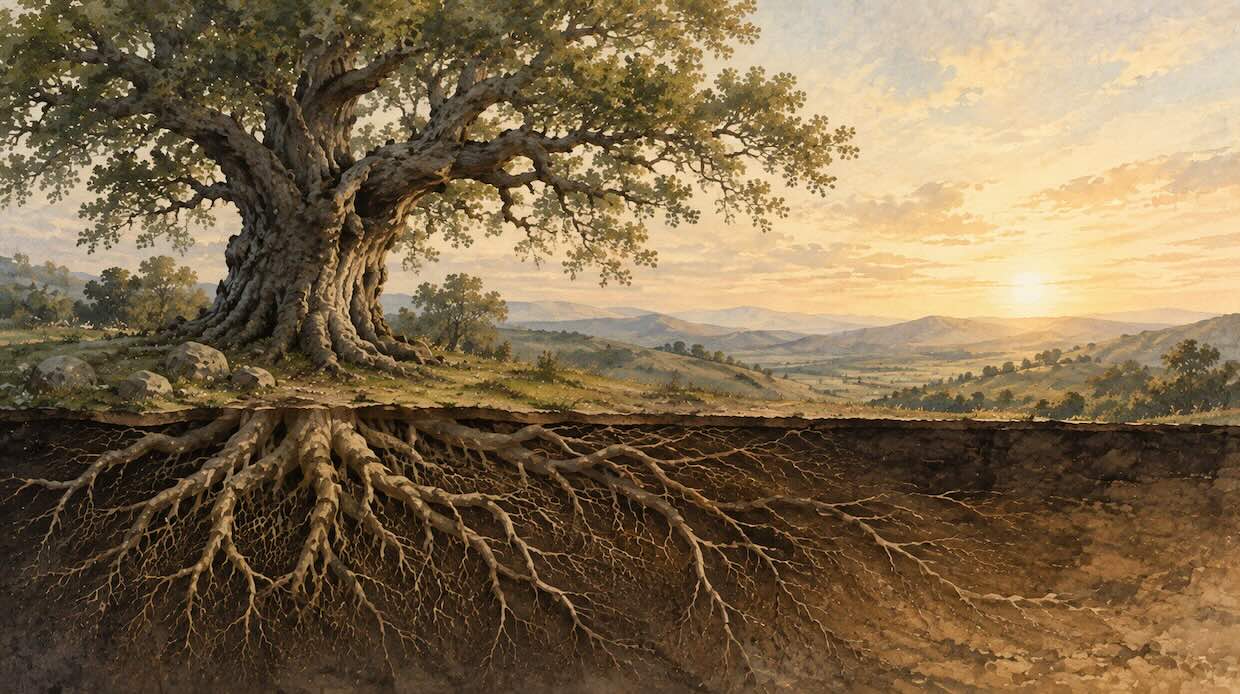
An old tree tells much of its story above ground. Years in the trunk. Broken limbs. New growth around old wounds. Evidence of drought and storm, seasons generous and lean.
Below ground, another story. Roots descend into darkness, encounter stone, divide, change direction, continue. What supports the visible tree is largely invisible.
Human beings are not trees, and suffering should never be romanticized as necessary for growth. Some losses remain losses. Some wounds do not make anyone wiser or stronger. Given the choice, there are experiences most people would erase without hesitation.Yet they happened. And what happens to us becomes part of what we bring to whatever happens next.
The person who once survived a devastating loss knows that grief can be survived, even when another loss feels unbearable. The caregiver who learned to function through exhaustion knows capacities that were once untested. Someone who rebuilt a life after failure or disappointment does not face the next uncertainty as the same person who faced the first.
The roots have gone deeper.
This may be one reason sisu takes on a different meaning in later life. Strength is no longer an abstraction or a quality admired from a distance. It has a history.
Some of that history is visible. Much of it is underground. There is, however, a problem with sisu.
We tend to admire perseverance without asking where it is taking us. The person who refuses to quit is courageous. The person who keeps fighting is strong. The person who withstands one more hardship earns our respect. Until perseverance itself begins to do harm.
That possibility emerged when Finnish researchers developed the Sisu Scale, an attempt to measure a quality that had existed for centuries without much scientific scrutiny. Their findings confirmed the qualities we would expect: latent strength, an inclination to act, extraordinary perseverance. But another form of sisu appeared as well. They called it harmful sisu.
It showed itself in three ways: harm to reason, harm to oneself, and harm to others. People can push beyond sensible limits, become blind to better choices, or demand from those around them the same relentless endurance they demand from themselves. In the study, beneficial sisu was associated with greater well-being; harmful sisu with greater stress and lower well-being.
The distinction changes the conversation. There are times when another step is an act of courage. There are times when another step takes us farther in the wrong direction.
Later life gives that distinction particular urgency. For decades, strength may have meant taking care of things ourselves. Then comes the day when strength means accepting help. We may have learned to fight through pain, until the wiser choice is to listen to what the body is saying. We may pride ourselves on carrying other people’s burdens, until carrying them begins to break us.
Sisu, then, cannot mean persistence at any cost. Lahti’s work describes its constructive form not only as extraordinary perseverance and latent strength, but as “gentle power.” The same force capable of carrying us beyond our assumed limits can become beneficial or harmful depending upon how it is used.
That is where strength becomes harder to recognize.
It is easy to see strength in the clenched fist, the determined face, the person who says, “I can do this.” Harder to see it in an open hand.
In the request for help.
In the decision to stop.
In the admission that something cannot be changed.
Thomas Merton spent much of his life examining that other kind of strength. Near the end of his life, he wrote of how much remained “to learn,” “to deepen,” and “to surrender.”
Surrender is an uncomfortable word in a culture that prizes perseverance. It sounds like defeat.
Sometimes it is. And sometimes refusing to surrender is the defeat.
An old tree survives storms through strength, but strength alone is not enough. A branch that cannot give eventually breaks. Roots meeting stone do not defeat the stone. They find another way.
Perhaps the deepest form of sisu is not the refusal to yield. Perhaps it is knowing what must never be yielded—and what finally must.
There remains one question that neither perseverance nor surrender can answer by itself. What makes something worth enduring?
Václav Havel knew something about perseverance without any guarantee that perseverance would prevail. A playwright and leading dissident under Communist rule in Czechoslovakia, he was repeatedly imprisoned for his political activities, including nearly four years from 1979 to 1983. A decade later, following the 1989 Velvet Revolution—what Havel called the “Gentle Revolution”—he became president of Czechoslovakia. When the country peacefully divided in 1993, he became the first president of the new Czech Republic.
His understanding of hope had been forged long before any of that seemed possible. In Disturbing the Peace, he drew a distinction between optimism and hope.
Hope, he wrote, is “not the conviction that something will turn out well, but the certainty that something makes sense, regardless of how it turns out.”
That may bring us closer to the spiritual dimension of sisu.
Endurance becomes something different when it has a reason. A caregiver gets up again because someone is loved. A person grieving a spouse begins another day because life, diminished as it may feel, still makes a claim upon the living. Someone undergoing months of rehabilitation continues because there is a grandchild to hold, a garden to tend, a friend expecting a telephone call.
The reason need not be grand. Sometimes enough for the day is enough.
Perhaps this is where later life changes our understanding of strength. Its younger version is easy to recognize: muscle, ambition, stamina, the determination to overcome whatever stands in the way. Years complicate that picture. Eventually we encounter obstacles that cannot be conquered and losses that cannot be reversed. Strength must learn another language.
Endurance, yes. But also judgment. Adaptation. Acceptance.
And surrender, when surrender is called for.
Consider again the old tree. A limb gone here. Bark split there. A trunk no longer straight. Beneath it, roots that have spent decades meeting whatever the earth placed before them. Stone did not move for the roots.The roots moved around the stone.
Perhaps that is why Jung’s image stays with us. The tree reaching toward heaven depends upon roots reaching into places where no sunlight falls. Its strength is not the absence of damage, nor an endless refusal to yield. What appears above ground is inseparable from what has happened below it.
There will be weeks when strength comes easily, when life asks no more than we can give. And there will be weeks when the reserves William James described seem beyond reach, when getting through the ordinary business of living requires more than anyone else knows.
The weeks when we’re weak. Those may be the weeks when sisu matters most.
Not because it promises that everything will work out. Havel knew better than that. Not because suffering inevitably makes us stronger. Life provides too much evidence to the contrary. And not because perseverance is always the answer. Sometimes the brave decision is to stop.
Sisu offers something less certain and perhaps more useful: the possibility that when life asks for strength we do not believe we possess, there may still be something left.
A root we didn’t know had grown.
A reserve we had never needed.
Or, when our own strength truly is exhausted, another hand within reach.
Above ground, the old tree weathers another season. Below ground, its roots find their way through darkness and stone.
Still growing.
Still here.
Join the conversation. Share your thoughts in the comments below. The experiences and insights readers bring to these questions are an important part of Spiritual Seniors.
If Spiritual Seniors adds something meaningful to your week, please consider supporting our work. Reader support helps keep our articles and Spiritual Signals available to everyone.
Related spiritual themes: ego and aging, jung, seasons, spiritual resilience
Reader submissions may be lightly edited for clarity and length, while preserving the writer’s original voice.



LS Pomeroy August 16, 2026
Words and how we use them have long been my focus. I consider myself an inspirational word-weaver. Sisu is welcome addition to my vocabulary.
This article is educational, insightful and encouraging, touching on the less-spoken-about realities of being here on Earth. I so appreciate the writer’s word-weaving and takeaways. Thank you!
I’ve been in this body more than 6 decades. I’ve survived two brushes with death, inexplicable health issues that doctors rarely solved, and personal losses that impacted every part of me, body-mind-spirit. Openly loving and creative writing are my ways through challenges along with conversational prayers to/with all in the heavens.
With much gratitude,
LS Pomeroy