

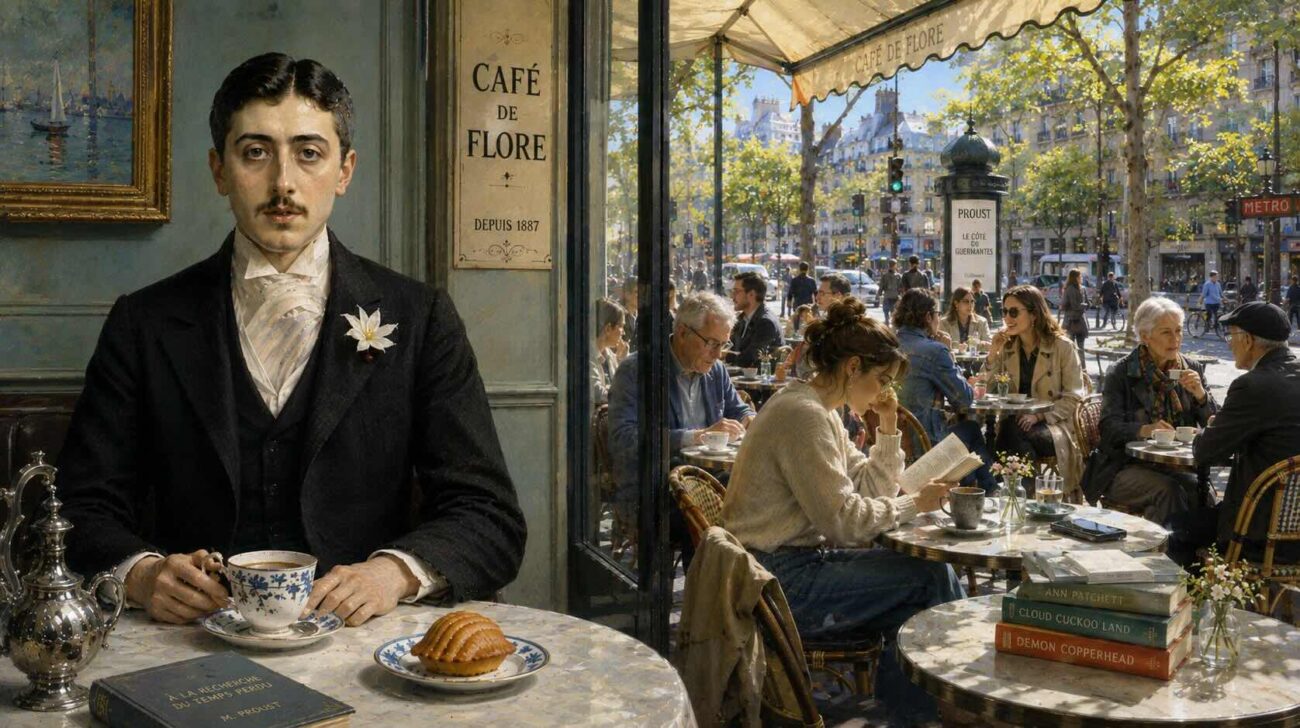
Marcel Proust, the French novelist who spent much of his life exploring memory, time and the hidden workings of human experience, was drinking tea when something happened that he could not explain.
Proust was born in Paris in 1871 and is best known for the monumental novel In Search of Lost Time, written in seven volumes and published over fourteen years. Its length alone has made Proust one of those writers many people know by reputation without ever having read.
But one brief scene from that enormous work has escaped the books and entered our culture.
Proust had taken a bite of a small French cake called a madeleine, softened in his tea. Almost at once he felt an unexpected rush of pleasure. He knew it had something to do with the taste, but he could not say why.
So he tried again.
Another taste. Another attempt to catch whatever had stirred inside him. At first, nothing. Proust described searching for the memory as though looking down into a depth where something had disappeared from view.
Then it came.
The taste belonged to Sunday mornings in Combray, where his aunt Léonie had given him a piece of madeleine dipped in tea. But what returned was far larger than the cake. The old house appeared in memory. Then the town. The square, the streets, the roads, the gardens, the church. An entire world that seemed to have vanished was suddenly present again.
Nothing outside Proust had changed. Inside, almost everything had.
We tend to think of the inner life as the place where our thoughts occur. Spend enough years living, though, and it becomes much more crowded than that. Memory lives there. So do imagination, desire, conscience, fear, faith, doubt, regret, old arguments, unfinished conversations and people who have been gone for decades.
Earlier versions of ourselves live there too.
The child who once occupied a bedroom that belongs to someone else now. The young adult certain of things that no longer seem certain. The parent whose children needed her in ways they no longer do. The person who made a decision forty years ago without knowing where it would lead.
The outer life moves on. The inner life keeps collecting.
Alain de Botton returned to Proust nearly a century later in How Proust Can Change Your Life. Beneath the book’s deliberately cheeky title was a serious proposition: literature can teach us to look more carefully at lives that familiarity has made difficult to see. De Botton’s Proust is interested in attention—in recovering the richness of experiences and ordinary things we have stopped noticing.
That becomes an interesting proposition in later life. There is simply more to notice.
Not necessarily more wisdom. Certainly not fewer contradictions. But more territory. More people we have loved. More things we have lost. More choices whose consequences we have lived long enough to see. More experiences capable of changing their meaning when viewed from another point along the road.
A smell from a childhood kitchen. A song heard unexpectedly in a store. Someone’s handwriting on an old envelope. And suddenly, Combray. Or our version of it.
An entire life within the life everyone else can see.
Traditions Speak
Human beings were exploring that unseen territory long before anyone called it an “inner life.” The traditions disagree about what we will find there—and sometimes about whether the self doing the searching is quite what we imagine it to be. But across centuries, they have developed practices for turning attention inward.
✝️ Christianity
Christian contemplative traditions have long treated the interior life as a place of encounter with God. Prayer can move beyond asking and speaking toward listening, examination and attention. The inward journey is not meant to become permanent retreat from the world; contemplation is expected to change the way a person returns to it.
✡️ Judaism
Jewish tradition includes cheshbon hanefesh—an “accounting of the soul,” an honest examination of one’s actions, motives and character. The practice becomes especially prominent around the High Holy Days, but its purpose reaches beyond remorse. Looking inward becomes a means of seeing where repair, return and renewal are needed.
☪️ Islam
Islam places great importance on the condition of the heart and on the continuing struggle with the nafs, the impulses and desires of the self. Reflection and self-examination are not ends in themselves. The interior life requires cultivation: recognizing pride, resentment, envy and selfish desire while developing gratitude, patience, humility and awareness of God.
🕉️ Hinduism
The Upanishadic traditions turn the search inward with extraordinary intensity. Beneath the changing experiences, roles and identities of ordinary life lies Atman, the deepest Self, whose relationship with ultimate reality becomes one of Hindu philosophy’s great questions. The interior journey therefore asks something more radical than “What am I thinking?” It asks, “Who is the one having these thoughts?”
☸️ Buddhism
Buddhism complicates the idea of an inner self. Mindfulness asks us to observe thoughts, feelings and suffering closely without assuming that everything arising within us defines who we are. In the Plum Village tradition, practitioners are encouraged to recognize and listen to suffering rather than flee from it, while also loosening attachment to fixed views of the self.
☯️ Taoism
Taoist thought approaches the interior world with less appetite for analysis. The Tao Te Ching repeatedly values stillness, simplicity and freedom from compulsive striving. Not everything within us needs to be interrogated or improved. Sometimes clarity comes when agitation ceases and we stop trying so hard to produce clarity.
🧠 Modern Psychology
Psychology gives the inner life a different vocabulary: memory, emotion, cognition, identity, unconscious processes, attachment and the stories through which we understand ourselves. It also adds an important caution. Memory is reconstructive, introspection can mislead us, and the explanation we give ourselves for why we behaved a certain way may not be the whole explanation. An inner life deserves attention, but not everything we find there should automatically be believed.
Perhaps that disagreement among the traditions is useful.
Look within, they tell us.
But they don’t tell us that everything within is wise.
Some things deserve examination. Some need forgiveness. Some need changing. Some can simply be observed and allowed to pass. And occasionally something we thought had disappeared long ago returns with the taste of a cake dipped in tea.
Proust’s madeleine did not leave him trapped in the past. It gave him another way of seeing it.
Later life offers plenty of madeleines.
They may arrive as music, photographs, places, books, conversations or people we haven’t thought about in years. What returns may delight us. It may trouble us. It may contradict the story we have told ourselves for decades.
But there it is.
The inner life is not somewhere else we go. We have been building it all along.
What has your inner life revealed to you lately? Has a memory, book, song, place or unexpected moment caused you to see part of your life differently? Share your thoughts in the comments below.
Spiritual Signals exists for conversations like this—bringing spiritual traditions, psychology, literature and lived experience together as we explore later life from inside it.
If these conversations add something to your week, please consider becoming a supporting member and helping make them possible for everyone.
Related spiritual themes: awareness, inner life, jung, spiritual aging