

Last Wednesday began with family.
They were visiting from out of town, and I suggested we spend the morning together at one of my favorite places. It wasn’t part of anyone’s itinerary. It was simply somewhere I wanted to share.
People occasionally ask where these articles come from. Part of the answer is an old brick school building. The Spiritual Seniors office occupies the second floor of a former middle school built in the 1930s, just a couple of blocks from the Atlantic Ocean in southern New Jersey. The classrooms have long since become offices, but downstairs, where generations of children once hurried through the halls, a preschool now fills the building with another generation of young voices.
Most afternoons, if I pause from writing for a moment, I can hear them through my open window: laughter, negotiations over toys, the occasional disagreement that seems all-consuming until, thirty seconds later, everyone is friends again.
I’ve never found those sounds distracting. If anything, they’ve become part of the rhythm of this place. They are small reminders that life keeps beginning, whether we happen to be paying attention or not. That morning, however, I wasn’t thinking about work.
A few minutes away, beside the Church of the Redeemer in Longport, is an outdoor labyrinth. It is a full-scale replica of the labyrinth at Chartres Cathedral in France, where pilgrims have walked the same winding path for more than eight centuries. I have been returning to the Longport labyrinth for years—sometimes before writing, sometimes after difficult conversations, sometimes because I simply feel pulled toward it.
When I first learned that it had been patterned after Chartres, I became fascinated by the ancient idea of sacred geometry—the belief that certain forms and proportions somehow encourage contemplation. Whether that is something science could ever measure, I honestly don’t know. I only know that walking the labyrinth has always had a curious effect on me. It never tells me what to think. It simply makes it easier to listen.
Unlike a maze, a labyrinth offers no choices. There are no wrong turns to correct, no dead ends, no puzzles to solve. There is only a single path that winds toward the center before carrying you back out again by the very same route.
Three of us entered that path together that morning. For the most part, we walked in silence. That never seems awkward in a labyrinth. Conversation has a way of giving itself permission to rest there.
As the path curves back and forth, the people walking beside you seem to disappear and reappear in unexpected ways. One moment they are only a few feet away. A few turns later they seem much farther than they really are. Then, without either of you changing direction, they are beside you once more.
There is something strangely comforting about that rhythm. Perhaps it reminds us that closeness is not always measured in feet. Or perhaps it means nothing at all. I have learned to leave some experiences alone.
When we reached the center, none of us hurried away. We stood there for a while before beginning the slow walk back out. It wasn’t a dramatic morning. Nothing extraordinary happened. There were no revelations waiting in the center of the labyrinth. Yet as we walked, I became aware of something I recognized from previous visits. It was one of those mornings when thoughts seem to gather beneath the surface before they have found words. No great insight had arrived. If someone had asked what I was thinking about, I would not have known how to answer. I only knew that something inside me felt unusually receptive.
When we left the church grounds, we drove the short distance to the rock jetty at the southern end of our island. I’ve loved that place for as long as I can remember. It’s where the island ends.
Standing there, the Atlantic stretches away in one direction while the back bays open in another. Water surrounds you in almost every direction, and something about that meeting of land and sea seems to put ordinary concerns into better perspective. The tide was low that morning. The rocks were coated with dark moss, making every step a careful one. The air carried that unmistakable fragrance of salt water, seaweed, and shellfish that belongs only to places where the sea has been shaping the land for centuries.
We stood there breathing it in. We did not talk very much. There wasn’t much to add.
Farther out on the rocks stood a fisherman. He was well equipped, his gear carefully arranged around him, and he carried himself with the concentration of someone who had done this many times before. We asked what he was hoping to catch. He answered graciously, then turned his attention back to the water. As we continued walking, I remember thinking that although he certainly wanted to catch fish, it somehow didn’t seem like the only reason he was there.
Some places seem to ask us to become quieter versions of ourselves. Perhaps that is why we return. Or perhaps we return because those places help us remember someone we had almost forgotten.
Eventually my family drove me back to the office before returning to their hotel. I watched them pull away, walked through the side door, and climbed the familiar staircase to the second floor.
The office was exactly as I had left it a few hours earlier. I set my keys on the desk, took off my sunglasses, put on my reading glasses, and opened the laptop. The article I had planned to write that afternoon was waiting patiently on the screen.
Or so I thought.
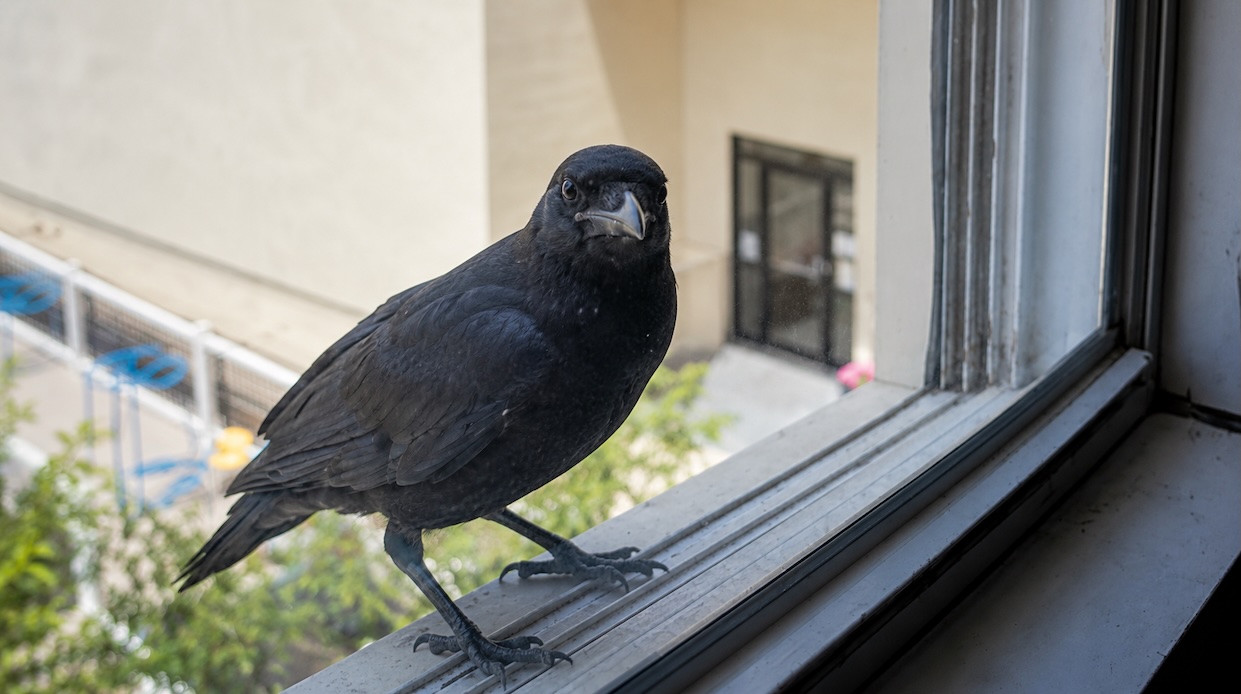
The office window beside my desk was open a few inches, letting in the ocean air. Then I heard it. Not loudly. Just enough to make me turn toward the window. There, on the outside sill, perched only inches below the partially opened sash, sat a crow.
My first thought was entirely practical. It will fly away. Wild birds don’t usually wait for company, and I assumed this one would disappear the moment I stepped toward the window. It didn’t. I walked closer. Nothing. Perhaps it hadn’t noticed me. I took another step.
Still nothing.
The crow remained exactly where it was, as though sitting outside second-floor office windows was an ordinary part of its day.
I smiled.
Then I noticed something else. Because it was perched directly beneath the lower sash, I couldn’t simply close the window. The frame would come down on top of it. So I made a gentle motion with my hand, hoping to encourage it back toward open air. The bird watched me. That was all. After another moment I tried again, this time with a slightly broader wave of my hand. It shuffled sideways only an inch or two.
Just enough.
I slowly lowered the window, then stepped back. The crow remained exactly where it was.
By now I had stopped thinking about work. Curiosity has a way of rearranging our priorities. I found myself standing there, looking through the glass. Every so often the crow made a soft sound.
I hesitate to describe it because I know so little about crows. It wasn’t the harsh caw we hear echoing across neighborhoods or parking lots. This was quieter. More conversational somehow. It sounded less like a warning than an observation.
Then it turned, slowly and deliberately, until it was looking directly at me.
Most of us never really see a crow. We notice them, identify them, and move on. Standing only a foot or two away, I realized I had never actually looked at one before. Its feathers weren’t simply black. They caught the morning light in subtle shades of charcoal and blue. Its beak looked almost sculpted. But it was the face that held my attention. The closest description I can offer, strange as it sounds, is that it looked like a benevolent alien. Not frightening. Not mysterious. Simply other.
Its eyes seemed impossibly alert. Ancient somehow. Intelligent in a way I found difficult to explain without worrying that I was giving the bird qualities it did not possess.
Perhaps every crow looks that way when we slow down long enough to really see one. Until that Wednesday, I had simply never stood still long enough to find out.
For reasons I still can’t explain, I had the distinct impression that it wanted me to open the window again. Not because it wanted to leave, but because it wanted to come inside.
Even now, writing those words, I realize how unusual they sound. I’m not asking you to believe they were true. I’m only trying to describe the experience as honestly as I remember it.
Instead of opening the window, I reached for my phone. I took several photographs and sent them in a text to my family, who had dropped me off only a short time earlier and were already on their way back to the hotel. I don’t remember exactly what I wrote. Probably something simple.
“Look who’s outside my office.”
I wasn’t trying to preserve evidence. I simply wanted to share something unexpected. Then I put my phone down.
The crow was still there.
I don’t know how long we remained that way. Long enough that I stopped wondering when it would leave. Long enough that the surprise slowly gave way to something deeper. The morning began returning to me: the slow turns of the labyrinth, the silence we had shared, the smell of salt water at the jetty, the fisherman standing patiently over the tide, pursuing something that seemed to matter for reasons beyond whatever he hoped to catch.
It occurred to me that the entire morning had unfolded at a different pace than most mornings do. No one had been rushing. No one had been trying to fill every silence. Perhaps without realizing it, I had been paying closer attention all day. Then, almost without warning, another face entered my thoughts.
My closest friend. The one cancer had taken from us not long ago. I hadn’t been thinking about him a moment before. Now I couldn’t imagine why I wasn’t.
From there the memories widened almost on their own: family members whose laughter I can still hear, friends whose influence remains long after their voices have fallen silent, people who, in ways large and small, helped make me who I am.
Nothing about those memories felt forced. They arrived the way memories sometimes do—not because we summon them, but because something opens a door we didn’t know had been closed. Only then did a question enter my mind. Not forcefully. Not dramatically. Almost as gently as everything else that had happened that morning.
Could this somehow be a sign? I remember smiling at myself for thinking it.
I’ve lived long enough to be cautious about assigning meaning too quickly. Life has a way of humbling people who believe every coincidence must carry a message. And yet, I couldn’t dismiss the question quite as easily as I expected.
Not because of the crow alone. Because of the morning.
The warmth of family. The ancient path beneath our feet. The sea air. The patient fisherman. The unexpected stillness. The crow outside my window.
Each experience, taken by itself, was entirely ordinary.
Together, they felt like chapters of the same story.
If these reflections have been meaningful to you, you can support Spiritual Seniors and help sustain this work:
Support the work
Reader submissions may be lightly edited for clarity and length, while preserving the writer’s original voice.


Carl Sosebee July 5, 2026
Jim, Thank you for your beautiful piece, I DON’T KNOW. It touched me deeply; so beautifully written and capturing so deeply the mystery of signs and things we cannot explain yet mean so much on a deep level. After reading, I knew I’d walked the labyrinth at your side. Thank you, again, Carl
Jeanie Shrode July 5, 2026
I love this piece! On my daily nature walks I practice attunement, Paying attention to the slightest details that call me. I will often stop and just deeply observe, often having profound insight or a lesson I needed to learn. Creatures as teachers
Anne Plyler July 5, 2026
The synchronicity of listening to The Hidden Brain Podcast July 5 on spirituality, after attending a poetry reading about slowing down and “paying exquisite attention; notice how much there is in this moment for you to love”, by a friend in a place where my spiritual roots have been watered for over 70 years and where I had a series of mystical experiences, then discovering this insightful piece has left me profoundly touched. Thank you for putting into words some of my own mystical experience that I’ve been pondering for over 30 years and I still don’t know how to explain it except that it changed my life.