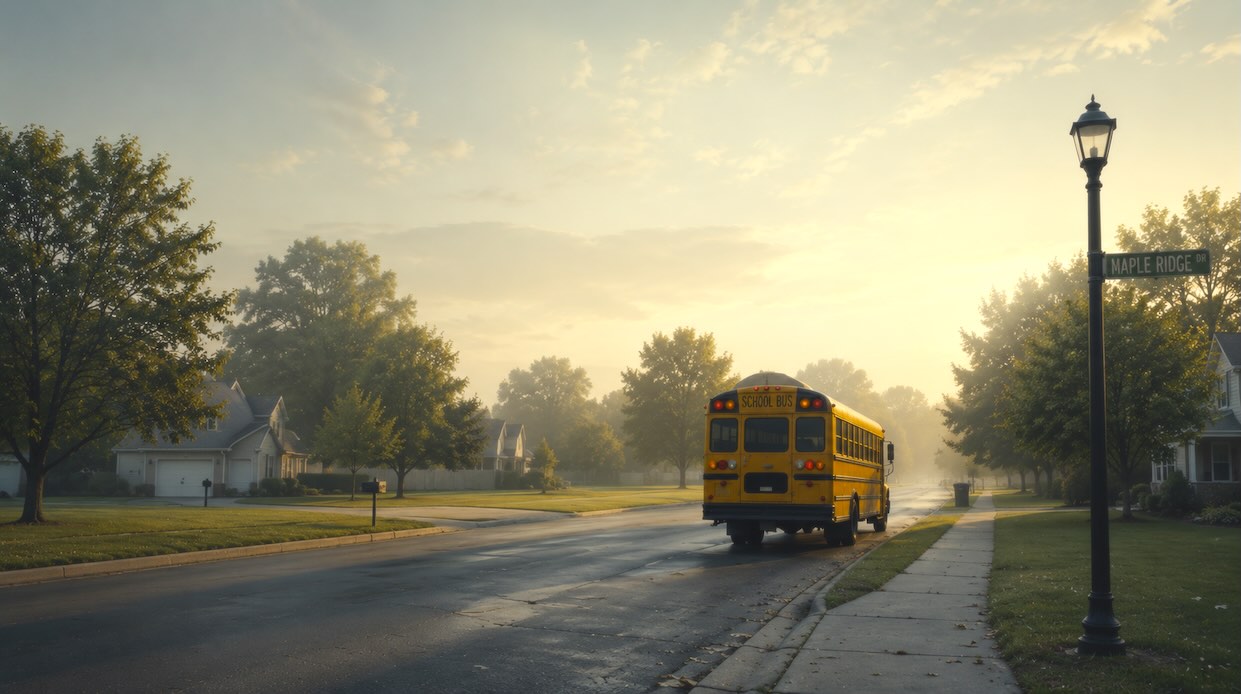


September has a sound.
There are fewer cicadas at night. Some birds leave while others pass through on their way south. Leaves begin to dry, changing the sound of wind in the trees. Soon we’ll hear them underfoot.
Scientists listen to these changes, too. Soundscape ecology uses recordings to study the sounds of a particular environment and how they change over time. Birds and insects have distinct daily and seasonal patterns, affected by temperature, humidity, vegetation and other conditions. The sound of a place really does change with the season.
The science of soundscape ecology was decades away when Oscar Hammerstein II and Richard Rodgers began work on Oklahoma!. The musical was based on Lynn Riggs’s play Green Grow the Lilacs. Hammerstein was struck by Riggs’s opening stage directions, which described an Oklahoma morning in vivid detail. He later recalled thinking it was a shame that the audience would never hear them. That description helped inspire the opening song, “Oh, What a Beautiful Mornin’.”
One line from the song says it well:
“All the sounds of the earth are like music.”
Curly hears cattle, a breeze and trees. The sounds were there for anyone to hear. He was listening.
On Sunday, we considered what September can bring back. School, the end of summer and other childhood associations can remain attached to the month long after the school years are over.
But there is another September happening outside those memories. Listening gives us a way to encounter it. Memory travels backward. Listening happens now. We don’t have to decide whether autumn is beautiful or sad, welcome or unwelcome. We can hear this September before comparing it with all the others. And listening also has an old place in spiritual life.
Traditions Speak
✝️ Christianity often treats listening as something more than hearing words. After telling the parable of the sower, Jesus says, “Whoever has ears to hear, let them hear” (Mk. 4:9). The seed has been scattered widely, but what happens next depends upon the ground that receives it. Listening, in this sense, asks what we allow to take root.
✡️ Judaism places listening in the first word of one of its central prayers: Shema—“Hear” or “Listen,” Israel. Traditionally recited morning and evening, the prayer begins not with an instruction to speak, but to hear. Jewish interpretation has also given shema the richer sense of hearing, understanding and responding.
☸️ Buddhism can turn ordinary sound into an object of attention. A bell, a bird or a passing noise arises and disappears; listening to that change offers a direct encounter with impermanence rather than an explanation of it.
🕉️ Hinduism has long given hearing a role in spiritual learning. Shravana—hearing or listening—is associated with receiving sacred teaching before reflecting upon it and making it one’s own. The sequence begins with receptivity: first, listen.
☪️ Sufism developed the practice known as sama, associated with listening. Poetry, recitation and music can become part of spiritual practice, directing attention toward remembrance of God. Listening in this setting is not background to the experience; it is part of the practice itself.
☯️ Taoism gives us one of the more unusual instructions. In the Zhuangzi, a student is told not to stop at listening with the ears or even with the mind, but to become empty enough to receive what is actually there rather than what he expects to find.
🪶 Indigenous wisdom resists being compressed into a single teaching, but Robin Wall Kimmerer’s work offers a particular example. As a botanist and Citizen Potawatomi Nation member, she writes about plants and the living world as sources from which human beings can learn; attention to a place becomes part of knowing one’s relationship to it.
🧠 Modern psychology gives listening another dimension. Attention determines how much of the flood of sound around us reaches conscious awareness. Familiar sounds can disappear into the background while an unfamiliar birdcall, a voice or a change in the usual pattern suddenly brings us back to where we are.
Eight paths don’t give us eight versions of the same teaching. But across them, hearing often becomes something more when attention enters the picture.
Another September
There is one more difference between this September and the Septembers we remember: the listener has changed.
At 70 or 80, we aren’t hearing the season as we did at 10 or 20. Some sounds have accumulated memories. Some have disappeared from our lives. Others may have been there all along without attracting much attention. Having lived through many Septembers doesn’t mean we already know this one.
Soon autumn will announce itself in color. Leaves will turn, pumpkins will appear, and the familiar pictures of fall will be everywhere. Before that happens, we can listen: a bird overhead, rain against a window, wind in the trees, the first dry leaves on the sidewalk.
Hammerstein heard music. Scientists hear a soundscape.
What do you hear?
What are the sounds that tell you September has arrived? Perhaps it’s one we’ve mentioned, or something particular to where you live. Join the conversation in the comments below.
Help Keep the Conversation Going
Spiritual Seniors is made possible in part by readers who believe conversations like these should remain available to everyone. If you value what you find here, please consider becoming a supporting member.
Related spiritual themes: impermanence, inner life, seasons