

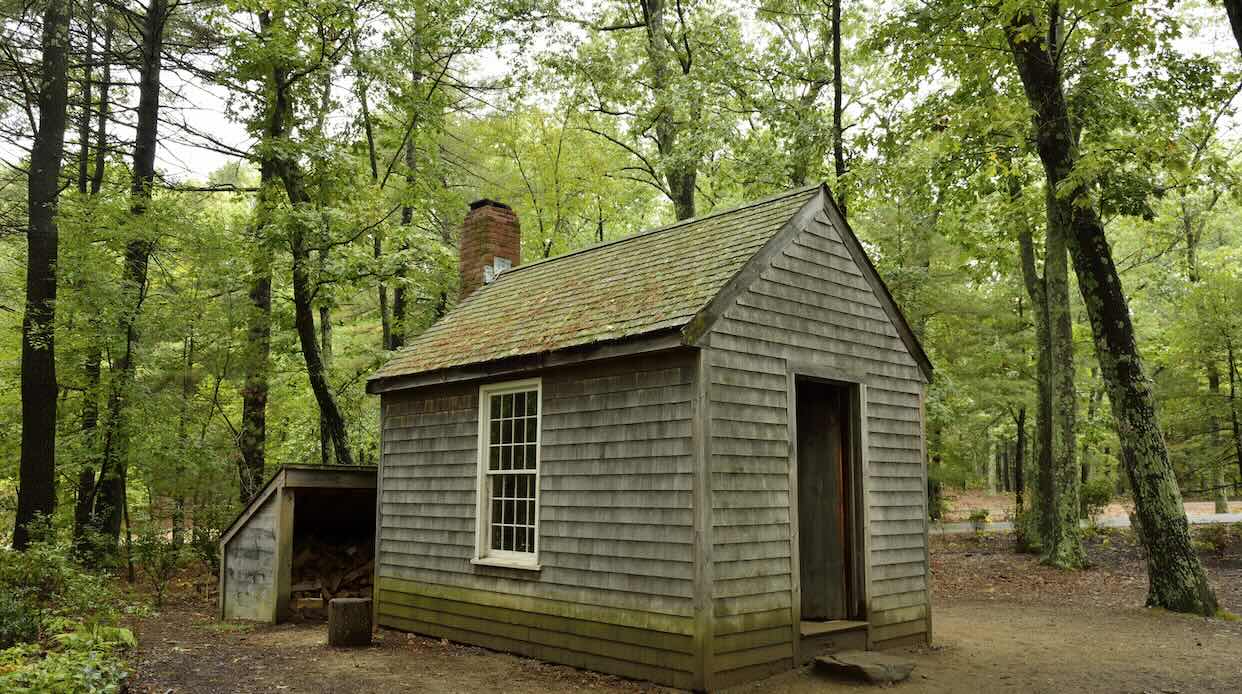
On this day, August 9, 1854, Henry David Thoreau published Walden: Life in the Woods, a book that is still inviting readers into the same conversation 172 years later.
Thousands of books have come and gone since then. Some were bestsellers in their day and are now largely forgotten. Others are remembered more for their place in history than for the pleasure of reading them. Yet every generation seems to rediscover Walden. because it asks questions that never grow old.
Many of us first encountered Thoreau years ago, perhaps in high school or college. We admired a few famous quotations, struggled through others, and eventually returned the book to the shelf. If that was your experience, you are in good company. But something curious happens when we return to Walden later in life. The words haven’t changed. We have.
The concerns that once seemed abstract now feel surprisingly familiar. The observations that once sounded idealistic now sound practical. A man writing in the language of nineteenth-century New England somehow finds himself speaking directly to the questions many of us ask in the second half of life.
That is the enduring gift of Walden. It is not a blueprint for how we ought to live. Instead, it is a reminder to examine how we already are.
The longer we live, the more we discover that some books are read only once, while others seem to wait for us to catch up with them. Walden belongs in the second category.
It is easy to forget how unconventional the book really is. Thoreau does not present a carefully ordered philosophy or argue a point chapter by chapter. Instead, he observes. He wanders. He notices things most of us walk past without a second glance. He asks questions, tells stories, interrupts himself, and occasionally makes us laugh. Reading Walden feels less like attending a lecture and more like taking a long walk with someone whose curiosity never seems to run dry.
His language reminds us that he belonged to another century. Some expressions feel quaint. Some references require a slower reading than they once did. Yet while Thoreau speaks in the cadence of the nineteenth century, he explores truths that belong to every century.
How much is enough?
What is the true cost of the things we own?
What deserves our attention?
How should we spend the days we have been given?
Those questions have occupied philosophers from the ancient world to the present. Psychologists continue to explore them. Spiritual teachers have wrestled with them for centuries. Thoreau did something different. He walked into the woods and turned those questions into an experiment. That experiment has often been misunderstood.
He was not trying to convince the world that everyone should build a small cabin, wear rough clothes, or give up the comforts of home. Those were never the destination. They were simply the means of clearing away distractions until the essentials of life stood plainly before him.
Again and again, Thoreau strips away what he considers unnecessary because he wants to discover what remains after comfort is no longer the measure of a life.
Sometimes his conclusions make us laugh.
“I would rather sit on a pumpkin and have it all to myself,” he wrote, “than be crowded on a velvet cushion.”
The image is humorous, almost mischievous. And it is vintage Thoreau. Yet behind the smile lies a serious question. How often do we surrender freedom, contentment, or peace of mind in exchange for comforts that promise more than they can ever deliver? That question has lost none of its power. If anything, it becomes easier to appreciate with age.
Most of us reach later life having learned, sometimes happily and sometimes painfully, that the things which seemed indispensable at forty no longer occupy the same place in our hearts. Suddenly, Thoreau’s argument no longer feels eccentric. It feels familiar.
❧
Continuing from today’s email
That is why Walden reads differently now because experience has prepared us for the conversation he began beside a small pond in Massachusetts more than 170 years ago.
One of the passages that has delighted readers for generations appears almost in passing. Reflecting on his walks, Thoreau writes:
“I frequently tramped eight or ten miles through the deepest snow to keep an appointment with a beech-tree, or a yellow birch, or an old acquaintance among the pines.”
Only Thoreau could write a sentence like that.
Most of us keep appointments with doctors, dentists, accountants, or friends. Thoreau kept appointments with trees because they had become familiar companions. A beech tree was no more an object than an old friend whose company he valued.
There is something beautiful about that. It reminds us that attention is one of the purest forms of gratitude. We cannot appreciate what we never stop long enough to notice. Perhaps that is another reason Walden seems to speak differently in later life. We have spent decades keeping appointments we could not miss—raising families, building careers, meeting responsibilities, paying mortgages, caring for parents, and later, perhaps, caring for spouses. Those years matter. They shape us.
Yet there comes a stage in life when the calendar begins to lose its importance. For the first time in many years, we are free to choose some of our own appointments. Some choose grandchildren. Some choose volunteering. Others discover painting, birdwatching, gardening, or long walks they never had time to take before.
Thoreau might simply ask: What has become worthy of your attention?
That question appears again and again throughout Walden. He has an almost relentless way of peeling back everything that is secondary until only the essential remains.
He examines clothing and asks what purpose it truly serves. He questions ever-larger homes and wonders whether we own them or they own us. He looks at labor, possessions, even the size of a fireplace, not because he delights in doing without, but because he is searching for something that cannot be purchased.
Read too quickly, those pages can sound like a lecture on simplicity. Read more patiently, and something else begins to emerge.
Thoreau is not asking us to admire his cabin. He is asking us to examine our lives. The distinction matters.
Most of us are not about to move beside a pond or spend our days growing beans. Thoreau knew that even in his own time. His little cabin was never intended to become a housing plan for America. It was an experiment—one man’s way of stripping life down until he could see more clearly what remained. And perhaps no sentence captures that better than this:
“The cost of a thing is the amount of what I will call life which is required to be exchanged for it.”
In other words, the true cost of anything is measured not only in dollars, but in the portion of our lives we exchange for it.
For many of us, those words take on a different meaning now than they might have years ago.
When we are young, we naturally measure cost in dollars. Later in life, we begin measuring it differently—in time, energy, peace of mind, attention, relationships, and, perhaps most precious of all, years. Thoreau asks us to consider a different kind of accounting—not what something costs us financially, but what it costs us to live.
A remarkable thing happens when we spend time with him. His words begin to feel less like a thoughtful friend walking beside us. He notices what we have overlooked. He points to what has been there all along. Occasionally he makes us laugh. Just as often he leaves us thinking.
Few books offer that kind of companionship.Fewer still offer it after 172 years. If you have never read Walden, perhaps this anniversary is an invitation to discover why generations of readers have kept returning to it. And if it has been years since you last opened its pages, you may find, as so many have before you, that you are not returning to an old book at all. You are returning to an old conversation.One that somehow seems to know exactly where you are in life.
As you close the book, you may even find yourself wishing you could ask Henry David Thoreau one question.
What would it be?
Related spiritual themes: community, discernment, ego and aging, integrity, Purpose
Reader submissions may be lightly edited for clarity and length, while preserving the writer’s original voice.


James Sarafin August 9, 2026
I would ask Henry David Thoreau if he ever achieved what he was seeking, which was himself. We can never discover ourselves unless we are living in the present and I wonder is Henry David Thoreau ever achieved that. To live in the present depends on where our attention is directed. When our attention is directed toward our conditioned selves we only discover who we ‘think’ we are, not who we actually are. To be in the present and discover who we actually are our attention must be directed toward our perceptions of the present, thoughtlessly.