

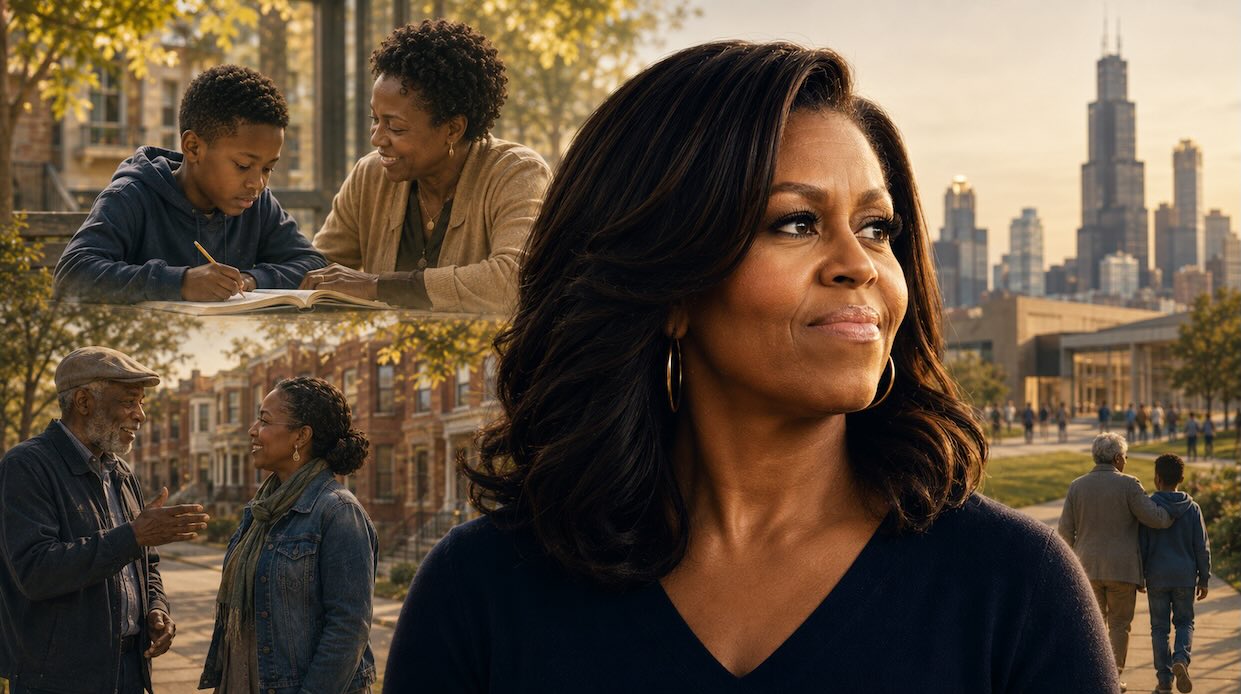
A few days ago, thousands of people gathered in Chicago for the official opening of the Obama Presidential Center. Organizers described it as a celebration of democracy, culture, service, and hope—a place intended not simply to preserve history, but to encourage people to participate in shaping their communities.
As I watched portions of the ceremony, I found myself returning to something Michelle Obama said several years earlier during the groundbreaking.
Reflecting on her upbringing on Chicago’s South Side, she said:
“This great city, this neighborhood, it courses through my veins. It defines me at my core. It makes me who I am.”
It is a remarkable sentence.
Here was someone whose accomplishments are known around the world—lawyer, author, First Lady, public figure—not describing her life as a story of individual achievement, but acknowledging the people and places that shaped her long before she became a public figure.
She began with belonging.
We often tell our own stories differently. We speak about the choices we made, the hard work we invested, and the milestones we reached. All of those things matter. But another story lives beneath them.
There is the teacher who saw something in us before we saw it ourselves. The friend who widened our world. The spouse whose patience softened our rough edges. The neighbor who always showed up. Even the difficult person who taught us what we valued most.
What is striking is that we seldom recognize their influence in the moment. We understand it afterwards. Years later, we may suddenly remember a sentence someone spoke to us decades earlier. We may discover that our habits, our values, and even the way we speak to others were borrowed from people who once walked beside us.
Some people accompanied us for fifty years. Others were present for a single season. Yet both may have left traces that remain with us still.
Perhaps one of the gifts of aging is that we finally have enough years behind us to see these threads. With time comes a perspective that was unavailable to us before.
Only later in life do many of us realize that we have been shaped by hundreds of ordinary encounters we barely noticed at the time. This recognition echoes a theme we explored in The Shape of the Soul: who we become is often the cumulative result of experiences, relationships, and choices that reveal themselves gradually.
During much of life, we are occupied with living it. There are jobs to do, people to care for, bills to pay, and responsibilities to meet. We keep moving forward, often without pausing to consider who is helping shape us along the way.
One of the gifts of later life is the opportunity to step back from the daily grind long enough to notice something we may have missed for decades: our lives have never been solitary projects.
Perhaps that is one of the understated surprises of growing older. We begin to understand that many of the things we once attributed solely to ourselves were, in fact, shared accomplishments. Someone encouraged us when we were uncertain. Someone believed in us before we believed in ourselves. Someone opened a door, extended an invitation, or patiently remained beside us while we figured things out.
No one arrives at later life entirely self-made.We explored a similar idea recently in The Burden We Share, reflecting on the ways our lives are intertwined with those around us.
That realization does not diminish accomplishment. If anything, it enlarges it. We begin to see our achievements not as solitary victories, but as the result of countless visible and invisible contributions along the way.
Our culture understandably admires independence. There is nothing wrong with that. But independence and isolation are not the same thing.
Even the most self-reliant among us have been supported by others. Every life contains an unseen network of encouragement, patience, forgiveness, and generosity. We may not always notice it while we are busy living, but later life often allows us to see what was there all along.
Perhaps this is why gratitude often becomes more accessible later in life: we can finally see how many hands helped shape our journey.
Gratitude, in turn, often gives way to something else: humility. This is not the kind that asks us to think less of ourselves, but a humility that enlarges the story we tell about our lives.
Humility begins when we stop seeing ourselves as the sole authors of our lives.
We often count our accomplishments. Perhaps later life invites us to count our influences.
Who encouraged us? Who challenged us? Who steadied us? Who forgave us? Who expanded our world?
The answers are rarely dramatic. More often, they are wonderfully ordinary: a conversation, a kindness, or a person who showed up consistently over many years.
And another realization follows. If others helped shape us, perhaps we are helping shape others right now—not through grand gestures, but through attention, encouragement, reliability, and the simple act of being present.Earlier this week, Relationships in Later Life introduced this same idea from another angle: we become ourselves, in part, through one another.
That thought can feel both comforting and humbling. We may never know the effect we are having on another person’s life. A phone call that we almost didn’t make. A note of encouragement. A habit of listening carefully. A simple act of showing up.
Many of the people who shaped us never knew they were doing so. The same may be true for us.
The very things we received may become the things we quietly pass forward.
“A life may belong to one person, but it is never built by one person alone.”
Perhaps that is one of the consolations of growing older.
We discover that we have never traveled alone.
We arrive carrying pieces of others, and one day, others will carry pieces of us forward—not in dramatic ways, but in habits, encouragement, stories, and ways of seeing the world.
Perhaps that is what Michelle Obama was acknowledging when she spoke about Chicago all those years ago.
She began with belonging.
Maybe that is where all of us begin.
And maybe, if we are fortunate, it is where we return.
Because a life may belong to one person, but it is never built by one person alone.
If these reflections have been meaningful to you, you can support Spiritual Seniors and help sustain this work:
Support the work
Related spiritual themes: belonging, community, gratitude, inner life
Reader submissions may be lightly edited for clarity and length, while preserving the writer’s original voice.


Kathy Bandstra June 27, 2026
Pastors I Have Known
They came in a procession, these shepherds of my soul — some who gave, some who took, and some who simply occupied the role like furniture.
Rev. G was first, the one you measure all the others against without knowing you’re doing it. He was simply there, solidly there, the way a good pastor should be — present without agenda, spiritual without performance.
Then Rev. B, and I was fifteen and didn’t have a name for what I felt. A secret crush, harmless and private, the kind that belongs to adolescence. His family chose me from among the other babysitters — chose me — and I carried that small distinction like a pressed flower. His children were challenging, his household complicated, and I showed up faithfully anyway. I understand now what that pattern of showing up looks like from the outside.
Rev. H came next and drove me out entirely. His judgment was a blunt instrument, and I was done. Sometimes leaving is the most spiritually honest thing you can do.
There was another pastor whose name I cannot quite recover — it keeps slipping — but I remember that his wife was a nurse. Some people stay with us in fragments.
Pastor M in Paddock Lake married us. For that alone he holds a particular place, the one who stood at the beginning of the life I actually wanted.
Pastor J had plans for me — activities, involvement, belonging — and then one day she had a different kind of plan, wanting me to broker a match between her daughter and my friend’s son, who was also her husband’s patient. The pastoral and the personal collapsed into something uncomfortable, and I recognized the feeling of being useful in ways I hadn’t agreed to.
Rev P a recent pastor wanted fifty years of ministry and got them, while the church quietly came apart around that milestone. There is a particular grief in watching someone tend to their own legacy while the living thing in their care goes unwatered.
My latest pastor’s ego arrived before she did and stayed after she left.
What I know now, looking back across this procession: the ones who had something real to give were the ones who weren’t using the role to fill something in themselves. They held the authority lightly. They didn’t need it the way the others did.
I kept going anyway — new church, new pastor, new hope. I used to think that was foolish. Now I think it might be the most resilient kind of faith I have.