
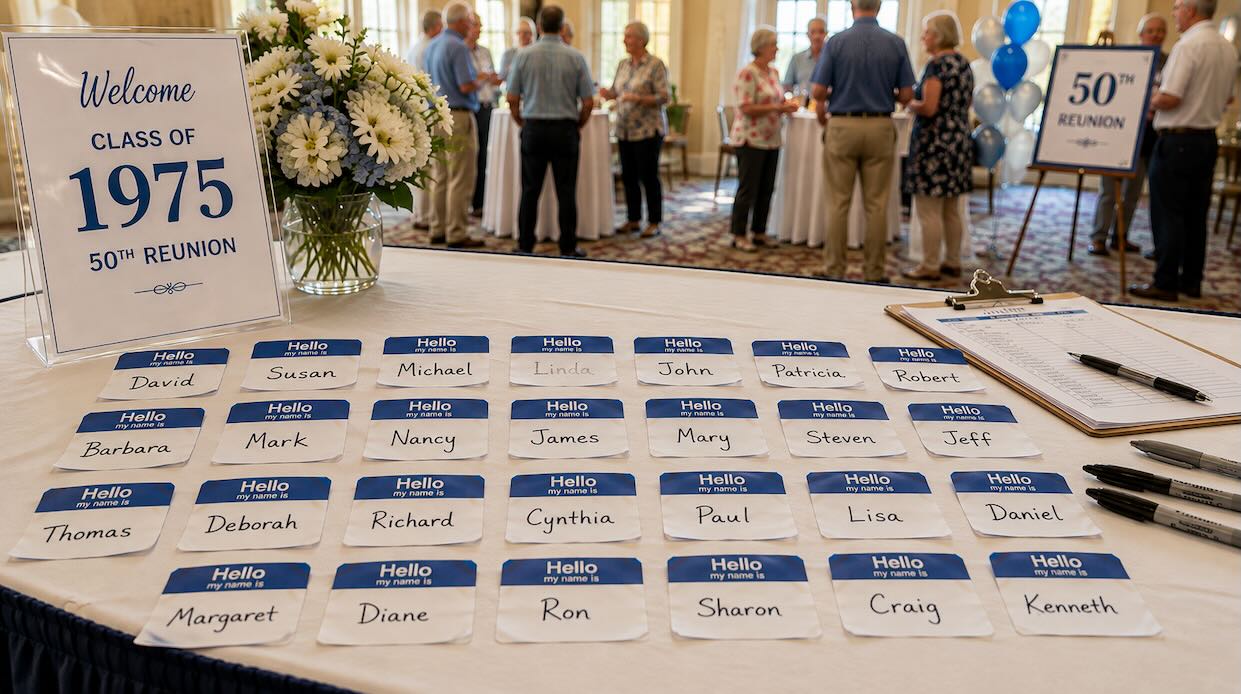
You see her across the room. You know her. You remember where you met. You remember that her husband is named Bob, that they went to Italy last year and that their daughter recently graduated from law school. You remember enough about her to carry on a perfectly respectable conversation, except for one small detail: her name.
Now you have choices. You can avoid saying anything that requires a name. You can wait hopefully for someone else to join the conversation and introduce themselves. You can try running through the alphabet in your head. Or you can surrender and say the sentence you seem to be saying more often these days: “I’m sorry. I know I know your name.”
Mark Twain apparently knew the feeling. According to his biographer Albert Bigelow Paine, Twain once joked, “When I was younger I could remember anything, whether it happened or not; but I am getting old, and soon I shall remember only the latter.” Twain was joking. Mostly.
If you can’t remember names as easily as you once did, you’re hardly alone. Difficulty retrieving names does become more common as we grow older. Older adults experience more of those maddening tip-of-the-tongue moments with proper names. But researchers have also found something rather comforting: names are unusually difficult things for the human brain to remember in the first place. The problem isn’t exclusively an old one.
Researchers discovered something curious when they showed people photographs of strangers and asked them to remember information about them. Take the word Baker. One person might be shown a photograph and told, “This man is a baker.” Another might see a photograph and be told, “This man’s name is Mr. Baker.” Later, people were more likely to remember the occupation than the name.
Same kind of unfamiliar face. Same word. The difference was what the word meant. Baker the occupation comes with connections: bread, flour, ovens, perhaps the bakery down the street. Baker the surname tells us almost nothing about the person who happens to have it. The brain has fewer places to attach it. The phenomenon became known as the Baker-baker paradox.
So there is our first bit of good news. It may not be your memory. It may be the name. And that gives us a clue about what to do: if a name arrives without meaning, give it some.
Suppose you meet Linda at a neighborhood gathering. Linda tells you her name, and five seconds later it is gone. One reason may be embarrassingly simple: you never really learned it. While Linda was introducing herself, you were preparing to introduce yourself, wondering where you knew her from, or thinking about what you were going to say next.
Researchers who study memory call this encoding. Before the brain can retrieve information later, it has to get the information in. So when someone says, “I’m Linda,” stop for a moment and listen to the name. Look at her face. Say it back naturally: “Nice to meet you, Linda.” Then give Linda somewhere to live in your memory.
Perhaps your sister is named Linda. Perhaps Linda lives on Linden Avenue. Perhaps she reminds you of another Linda you know. The association doesn’t have to be clever, and nobody else ever needs to hear it. Its job is simply to turn an arbitrary label into something connected to information already stored in your mind.
Research has found that names can be remembered better when people process them for meaning rather than concentrating merely on how they look or sound. Older adults can also benefit from generating their own associations. Even a visual connection between a name and a noticeable feature of a face can help.
And then there is perhaps the most obvious technique of all: make yourself retrieve the name. A few minutes after meeting Linda, try to produce it. Later that evening, remember the people you met and see whether you can retrieve their names again. Spacing out attempts to retrieve information can strengthen our ability to find it later.
There is something else happening here that memory researchers cannot measure quite so easily. Learning someone’s name requires us, for a few seconds, to give that person our attention. Not the half-attention of waiting for our turn to speak. Not the glance at the room to see who else has arrived. Attention. That may be a useful practice even on the occasions when the name escapes us anyway.
Of course, sometimes the problem isn’t learning the name. You know the name. You have known it for years. It simply refuses to come out. You can see the actor’s face. You know the movies he was in. You know who he was married to. You may even know that his first name begins with a B. Brad… nothing.
Psychologists call this a tip-of-the-tongue state. The information feels as though it is right there while the word itself remains inaccessible. These episodes become more common as we age, particularly with proper names. But a study of clinically normal older adults in the Harvard Aging Brain Study found something important: increasing tip-of-the-tongue experiences and declining ability to remember names were partially independent processes.
In other words, I know it but I can’t get to it really is different from I don’t know it anymore. So what should you do when the name won’t come?
Sound can help. Studies have found that phonological cues—the beginning or ending sounds of the missing name, for example—can help people resolve tip-of-the-tongue states, including older adults. Give yourself a moment. See whether you can recover a first sound, a syllable or some other piece of the name. Sometimes it will return on its own; sometimes a cue will bring it back. Sometimes it simply isn’t going to cooperate.
And if Linda is still standing in front of you, there is another solution: ask her. “I remember you, but I’m afraid your name has escaped me.”
There may be something important in that sentence. We tend to treat remembering someone’s name as a test of our memory. Perhaps it is better understood as an act of attention. A name is among the first things another person gives us. Learning it means that, however briefly, we have stopped thinking about ourselves long enough to notice someone else.
We won’t always remember. Our brains were never particularly good at names, and age doesn’t make the job easier. But we can listen more carefully. We can make connections. We can practice retrieving the name. And when all of that fails, we can simply ask again.
The goal, after all, isn’t to become better at remembering names. It’s to become better at remembering people. Because every time we make the effort to learn a name, we are practicing something larger than memory. We are paying attention. We are saying, in one of the smallest and most ordinary ways possible: I see you. You matter.
Join the conversation in the comments below. Your experience may bring back a memory of a once forgotten name or open a possibility for someone else.
Related spiritual themes: impermanence, mindfulness in later life, second half of life
Reader submissions may be lightly edited for clarity and length, while preserving the writer’s original voice.