

He turned fifty-eight last Thursday. Today he’s driven three hours in his Jeep, a pumpkin pie riding shotgun. Somewhere along the highway, he made himself a promise: “I swear, this Thanksgiving I will not let my brother get under my skin.”
Only last week, a young woman at the movie theater had asked, “Senior?” He is still recovering.
His brother’s car is already in the driveway.
He turns off the engine and sits for a moment. He wants to see his mother. He really does. But after three hours on the road, another nerve-racking minute or two hardly matters.
Dorothy Parker, that great student of human nature, once imagined her own epitaph in a story about an excruciating dinner party. It might just as easily have been written for Thanksgiving:
“Wherever she went, including here, it was against her better judgment.”
He rings the doorbell.
His mother throws her arms around him. The familiar smell of roasting turkey, onions, celery, and sage fills the house. Someone is setting the table. His older brother appears in the kitchen doorway and sizes him up.
“Well, look who’s finally on time.”
Everyone laughs. He manages a smile. After all, what’s the harm in a little brotherly teasing?
His mother looks from one son to the other.
“Boys,” she says, as she has said a thousand times before.
Then she takes the pie from his hands and heads for the kitchen.
Joe has raised children, managed employees, paid mortgages, and weathered disappointments his family knows little about. For decades, people have depended on him, trusted his judgment, and taken his word. He has grown older and, he thought, outgrown the need to prove himself.
Except, it seems, in his mother’s kitchen.
His brother has already turned away. The conversation moves on. Nobody gives the remark another thought.
But Joe is twelve again, standing before his brother, feeling the old embarrassment, wishing he could think of something clever to say.
For a moment, one careless remark has erased forty years of adulthood.
Meanwhile, his mother is making room for the pumpkin pie on the kitchen counter.
She is delighted to have both sons home. She wants a happy Thanksgiving, a good meal, a few hours together without an argument. Is that really so much to ask?
She has been saying “Boys” for more than half a century. Sometimes it was a warning. Sometimes a plea. Sometimes she said it simply because she had run out of patience. Today the word came out almost automatically.
Perhaps she recognized the familiar exchange and hoped to stop it before it started. Perhaps she heard nothing more than an affectionate joke between brothers. Perhaps she has spent so many years keeping the peace that she no longer notices what keeping the peace costs.
She remembers their childhood, too. The birthday parties, the scraped knees, the arguments over who got the front seat. She remembers loving them both, worrying about them both, doing the best she knew how.
But the childhood she remembers may not be quite the childhood either son remembers.
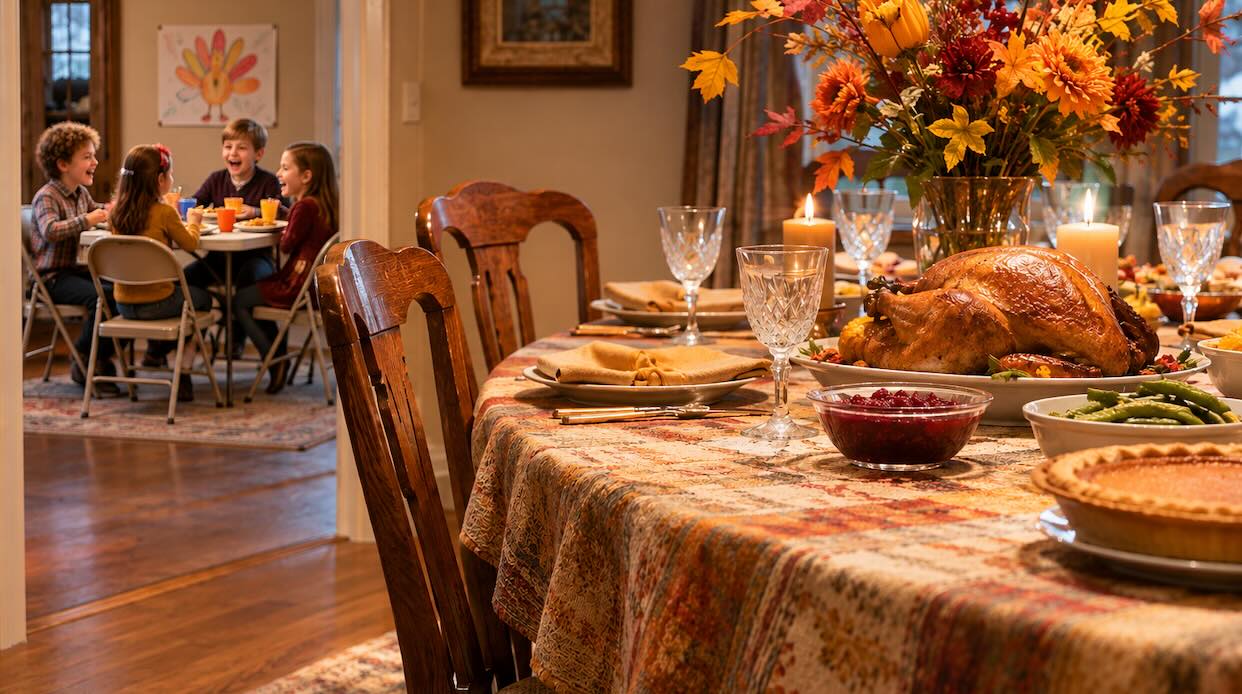
Still Sitting at the Kids’ Table
The folding card table and mismatched chairs disappeared years ago. The children have grown up, raised families of their own, and earned their places among the adults.
But the seating arrangements aren’t the only things that survive from childhood.
If any of this sounds familiar, you have a lot of company.
In a 2024 survey by the American Psychiatric Association, 35 percent of Americans worried about dealing with challenging family dynamics during the holidays.
Some families dread the inevitable argument. Others get along reasonably well until somebody says something that would mean nothing coming from anyone else.
Joe’s brother could make that joke at work, and a colleague might laugh. At his mother’s house, the same remark carries the weight of a hundred earlier remarks.
In a study published in Psychology and Aging, researchers found that tensions over how family members treat one another were more closely linked to strained relationships than disagreements about specific issues.
Consider the mother who asks her fifty-year-old daughter whether she remembered to bring a warm coat.
The mother hears an expression of concern. The daughter hears the same old suggestion that she cannot take care of herself.
Or the father who offers financial advice to a son who has managed a successful business for twenty years.
Neither parent necessarily intends an insult. But good intentions don’t always determine how a remark is received.
Researchers studying adults ages 45 to 65 have found that unwanted advice from aging parents can create tension, particularly when the relationship is already strained. Adults who had better relationships with their parents were less likely to regard advice as unwanted, even when facing difficulties in their own lives.
The history between two people can change the meaning of an ordinary sentence.
At its worst, this becomes infantilizing: treating a capable adult as though that person still needs the supervision appropriate to a child.
Yet the parent may experience the exchange quite differently. After decades of reminding children to wear coats, eat breakfast, or drive carefully, concern can become a habit that outlives the need for supervision.
And grown children bring their own habits home. They may anticipate criticism before anyone offers it, or hear an old judgment in a remark that wasn’t intended that way.
Joe has barely stepped through the door before he’s on familiar ground with his brother. His mother has barely looked at them before she’s saying “Boys.”
Neither has rehearsed the exchange. Both know their parts.
The Past at the Table
Then there are the memories themselves.
Researchers at Purdue University, Iowa State University, and Cornell University studied how mothers and their adult children perceived favoritism within their families.
They discovered something remarkable. Mothers and children reported similar overall rates of favoritism, but the grown children frequently disagreed with their mothers about which child was favored.
Imagine that conversation around the Thanksgiving table.
One son remembers that his brother always got away with everything. The brother remembers being held to a higher standard because he was older. Their mother remembers trying to be fair.
They might argue about it for hours without changing anyone’s mind.
Of course, memories can differ without everyone being equally right. Parents sometimes favor one child. Siblings sometimes inflict genuine hurt. And some families have histories that cannot be dismissed as misunderstandings.
But even in loving families, the past looks different depending on where you were standing.
Joe’s mother remembers the work of raising two boys. She remembers the times they were sick, the school conferences, the birthday cakes, the occasions when she had to intervene. She remembers how hard she tried.
Joe remembers how his brother made him feel.
His brother may remember something else entirely.
And none of them knows everything that happened in the lives of the others.
There is another complication, especially for the mothers and grandmothers who host these gatherings.
They have changed, too.
Their grown children may still expect them to organize everything, remember everyone’s preferences, and smooth over every disagreement. They may assume that Mom will cook the same dishes, occupy the same kitchen, and respond to the same jokes in the same familiar way.
They may correct her, dismiss her opinions, or exchange knowing glances when she tells a story they’ve heard before.
The woman who once reminded them to put on their coats may now find herself being reminded to take her medication or drive more carefully.
Sometimes that concern is welcome and necessary. Sometimes it carries an uncomfortable suggestion that she can no longer manage her own affairs.
She has had to learn to see her children as adults. Have they made the same effort to see her as someone other than their mother?
Her life has included friendships, ambitions, disappointments, and private concerns that had little to do with raising children. Yet around the Thanksgiving table, she can find herself playing a role she learned decades ago.
We remember who the people we love were. We may be slower to notice who they have become.
No one can rewrite an entire family history over Thanksgiving dinner. Nor should anyone feel obliged to excuse genuinely hurtful behavior simply because it’s a holiday.
The turkey is ready. Someone has opened another bottle of wine. The grandchildren have finally stopped asking when dinner will start.
Joe takes his seat beside his older brother.
“Hey, Joe. I saw a recipe the other day and it reminded me of you.”
Joe knows that tone of voice. He’s known it his whole life.
“Oh, yeah? What was it?”
“Chive turkey.”
Their mother looks from one son to the other.
“Boys.”
Editor’s Note: Joe and his family represent familiar dynamics that will play out in countless homes this Thanksgiving. We invite you to share your own experiences. Do you find yourself slipping into old family roles when everyone gets together? Or have you watched your grown children do the same? We’d love to hear your story in the comments.
Help Keep These Conversations Going
Questions about faith, doubt, and the meaning of our lives deserve thoughtful attention. Spiritual Seniors exists to make room for these conversations, and to keep them accessible to everyone, whether or not they can afford to contribute.
If you value what we publish, please consider becoming a Supporting Member. We’ve made it simple, with three ways to help:
Monthly: $5 per month
Annual: $50 per year
One-Time Gift: Any amount you choose
Your support helps sustain independent writing and the conversations that matter as we grow older.
Every contribution is voluntary. Our articles remain freely available to all readers.
Related spiritual themes: family, thanksgiving
Reader submissions may be lightly edited for clarity and length, while preserving the writer’s original voice.