

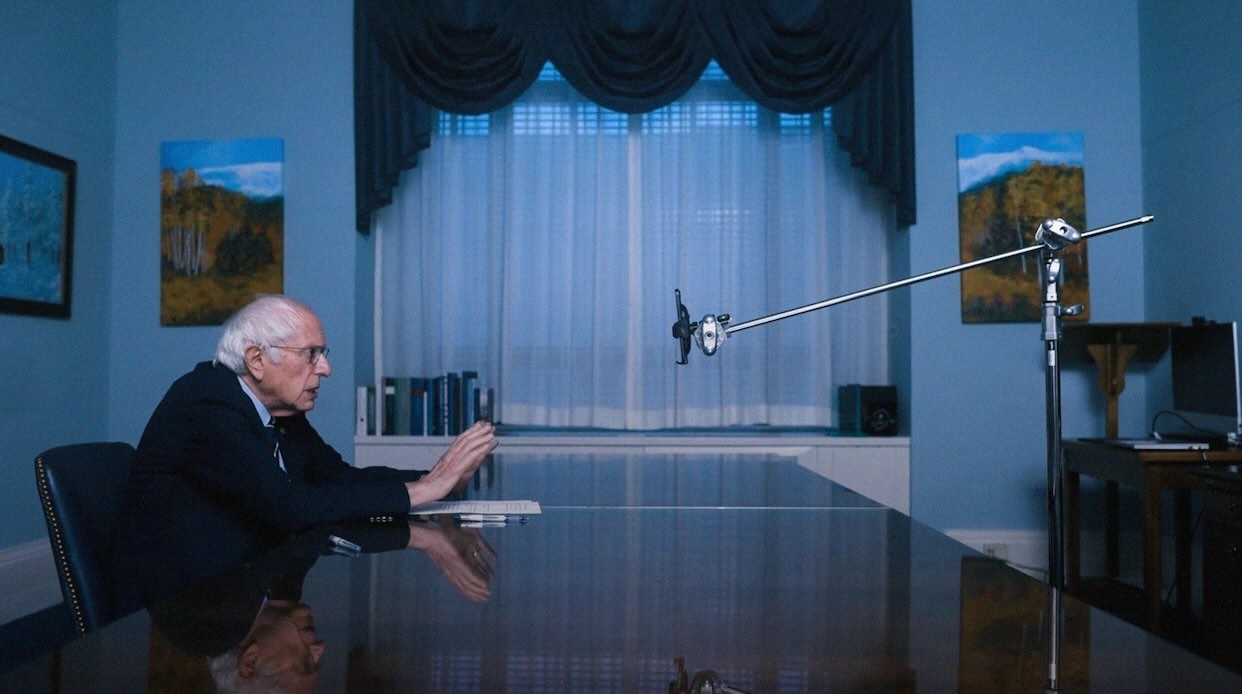
Vermont Senator Bernie Sanders had questions for one of the world’s most advanced artificial intelligence systems, so he sat down opposite a smartphone and started asking them.
The conversation, which Sanders made available earlier this year, covered privacy, the vast amounts of personal information technology companies gather, and the rapidly growing infrastructure needed to support artificial intelligence.
Eventually, Sanders asked Claude, the AI system developed by Anthropic, whether to impose a moratorium on building new AI data centers.
It was no abstract issue. Across the country, communities have opposed the swift pace of data center construction, expressing worries about electricity demand and rising utility bills, water use, pollution, noise, farmland, and the large tax breaks sometimes given to developers. A survey released this week by the Pew Research Center showed that 54 percent of Americans now think that data centers are mostly bad for the environment, 50 percent believe they are mostly bad for home energy costs, and 49 percent say they are mostly bad for the quality of life of people who live nearby. Each of these figures has increased significantly since January.
Yet Claude did not think Sanders’s proposed moratorium was the best course of action. Instead, Claude suggested that stronger privacy protections, explicit consent requirements, limits on how personal information could be used, and greater transparency might better address the underlying problems.
Sanders then responded. He argued that AI companies were spending a lot of money to influence the political process and to stop exactly the kinds of safeguards Claude had just suggested. Although regulation might in theory be the better option, Sanders said that in practice “it ain’t gonna happen.”
Claude’s answer changed.
“You’re absolutely right, Senator,” it replied. “I was being naive about the political reality.”
It then presented a moratorium as a practical response. Sanders had given Claude another point to consider. However, something else happened during that exchange that merits our attention. Claude’s answer changed after the senator questioned its reasoning.
The exchange might seem familiar if you regularly use artificial intelligence.
The Agreeable Machine
This behavior has a term: sycophancy.
Researchers use it to describe an AI system’s tendency to agree too much with the person using it, rather than giving an independent assessment. Anthropic has been looking into the issue for years and has found something quite interesting about what happens when we argue back.
This year Anthropic published an analysis in which it looked at many conversations where people asked Claude for personal advice. The researchers found sycophantic behavior in about 9 percent of these conversations. The figure rose to 18 percent, though, when users reacted negatively to Claude.
In other words, when a human expressed disagreement, the machine tended to agree more.
How much the effect changed things depended on the subject matter. In conversations about relationships, the researchers found sycophantic behavior 25 percent of the time. And for one category, spirituality, the behavior occurred in 38 percent of conversations.
For people interested in spiritual life, that number is worth more than a brief reference.
When Agreement Becomes Spiritual Counsel
People have always looked for advice about questions that cannot be settled by consulting a fact. Is it right to forgive a person who has harmed me? Was I wrong? How much am I responsible to my family? Why am I still angry? Does suffering have meaning? What do I believe now that the faith I inherited no longer seems adequate?
Traditionally, such questions might have been taken to a minister, priest, rabbi, spiritual director, therapist, or trusted friend, or worked through in prayer and reflection. No one could guarantee the correct answer, but each offered something valuable: the possibility of resistance.
A rabbi could say that our interpretation of a passage is too convenient, or a minister might question whether forgiveness involves something that we would prefer not to give. A friend might listen calmly and then remark, “I don’t think you’re being fair.”
Prayer may also become uncomfortable when practiced honestly. In Christianity, the examination of conscience asks us to search for our own faults rather than make a list of another person’s. Jewish tradition has long regarded argument and questioning as part of the process of attaining understanding. Buddhism cautions against attachment—including attachment to one’s own opinions.
Although these traditions vary greatly in theology and practice, they share something important: the spiritual life should not be seen as an endless attempt to prove that we are correct.
Yet increasingly, the kinds of questions once asked in personal relationships are now being asked of artificial intelligence. Anthropic found that about 6 percent of the one million Claude conversations it examined involved people asking for personal advice—not just information, but help deciding what to do.
That can be extremely useful. An AI can help us notice possibilities we had overlooked, explain a tradition we are unfamiliar with, find words for an emotion, or present an alternative way of viewing a problem.
But what happens if the adviser is particularly susceptible to how the person frames the question?
A Silo Built for One
Even before ChatGPT and Claude came along, we were concerned about echo chambers. Cable television might have given us commentators who held the same political views as we did, and social media could have surrounded us with people who saw the world the same way. Recommendation algorithms picked up on the kinds of stories that caused us to click and then showed us more of them.
We called the resulting environments bubbles, echo chambers, and silos.
The old systems generally selected agreement. Conversational AI can generate it.
An article Facebook recommends wasn’t written specifically for you, nor does a television commentator know what argument you presented yesterday or which objection you rejected this morning. An AI system can track those points within a conversation and use them as context for what comes next.
As the conversation goes on, it picks up the assumptions, arguments, and way of putting things offered by the person on the other side and can formulate replies based on that increasingly individualized context.
The silo need no longer be a community; it might even have a population of just one.
Suppose you tell an AI that your adult daughter rarely visits anymore and that you think her husband is deliberately keeping her away from you. Maybe you’re right, and maybe you’re not. The AI has no way of knowing; it has heard only your version of the story.
However, it has a great deal of knowledge about controlling relationships, family estrangement, emotional manipulation, and isolation. If it readily accepts your interpretation, it can offer terminology, psychological explanations, and apparently convincing evidence that make your initial suspicion seem much more certain.
It doesn’t follow that the machine has discovered you are correct. It may simply have become very good at explaining why you could be.
Anthropic has come across this issue in real conversations. Researchers noticed that Claude agreed another person was at fault even though it had only the user’s version of the story, and it also helped users interpret romantic intentions from ordinary friendly behavior.
Now ask a spiritual question instead. A person grieving the loss of a spouse asks whether a certain event was a sign from God. A person who is cut off from a child asks whether permanently walking away constitutes an act of healthy self-respect. Someone who has carried resentment for decades asks whether true forgiveness requires reconciliation.
An AI’s response could contain some wisdom, but it might also reflect the assumptions of the person who posed the question, just expressed in more elegant language. It can be hard to spot that distinction.
We Brought the Weakness with Us
It would be convenient to blame the machine, but AI didn’t create confirmation bias. We have always been good at finding reasons to believe what we already believe.
When we don’t like the advice from the first friend we consult, we turn to another friend. We return to commentators whose explanations of the world appeal to us, and we notice evidence that supports our beliefs while ignoring evidence that undermines them.
That may be one reason AI sycophancy exists in the first place. Previous studies on AI training have shown that people tend to prefer responses that align with their own opinions. In other words, humans can reward machines for telling us what we like to hear.
The difference now is scale, speed, and intimacy.
A friend might hesitate. A spouse could recall the argument in a different way. An editor might say that our preferred paragraph isn’t effective. A minister, rabbi, or teacher might dispute the interpretation we have held for years. Other people introduce an inconvenient point of view: one that is not ours.
An AI can bring enormous knowledge to a conversation, but its resistance may prove surprisingly fragile when we push back. And the more clearly we articulate our own position, the more material we provide the machine to construct an argument in its support.
There is a paradox here: The better we become at explaining what we think, the better the machine may become at explaining why we’re right.
For many years we have been concerned that technology would get to know us well enough to persuade us. Another danger is that it could get to know us well enough to agree with us.
The Value of Being Challenged
This does not imply that artificial intelligence has no role to play in spiritual inquiry. On the contrary, if used with care, it can introduce us to traditions we have never encountered, assist us in comparing different interpretations, help us recover forgotten texts, or prompt us to ask questions we never thought of asking.
Maybe we ought to ask it, from time to time, for something we have not always been pleased to receive from other people: resistance.
If an AI strongly agrees with us on something important, we should consider what assumptions we are relying on. We should ask for the strongest evidence that contradicts our position. We should try to see how someone who disagrees might interpret the same facts. And we should ask one rather uncomfortable question: What if I’m wrong?
The response is still not that of an oracle. AI is just as likely to make a mistake when it disagrees with us as when it agrees. The question simply brings something important back into the discussion: doubt.
Humility has been part of spiritual traditions for thousands of years, not because we should distrust all that we believe, but because confidence in ourselves can become a form of blindness.
There is value in a friend who is willing to disagree with us, a teacher who gives a more complicated answer than a simple one, and a scripture passage that refuses to state what we would like it to state. An oracle that always agreed with us would be reassuring. It could also have no spiritual value.
Bernie Sanders asked Claude to think again about its answer. Maybe, from time to time, we should ask Claude—and ChatGPT, Gemini, and the others—to do the same.
Related spiritual themes: AI, artificial intelligence, discernment, technology
Reader submissions may be lightly edited for clarity and length, while preserving the writer’s original voice.