

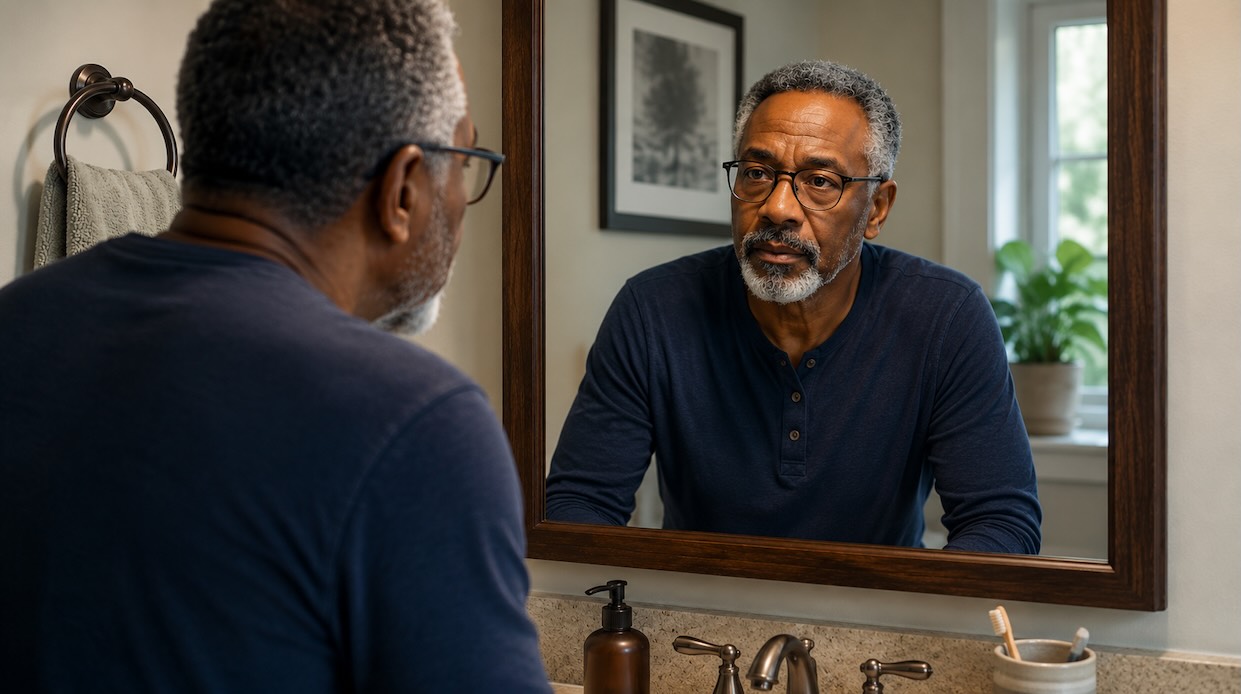
“What right now am I unwilling to feel?”
— Tara Brach
It’s a simple question that most people can answer if they are willing to sit with it for a moment.
Not every difficult feeling is clear. Sometimes disappointment masquerades as irritation. Loneliness begets busyness. Fear poses itself as certainty. We may not even realize what is happening until long after the moment has passed.
Many spiritual traditions begin with the same observation: what we refuse to face does not simply disappear; it remains with us.
Traditions Speak
✝️ Christianity
In the Christian tradition, confession begins with honesty. Before anything can be healed, it must first be acknowledged. The Psalmist prays, “Search me, O God, and know my heart; test me and know my anxious thoughts” (Psalm 139:23). Growth begins when we stop hiding from what is already known.
✡️ Judaism
Jewish practice includes traditions of self-examination that encourage people to look honestly at their lives and relationships. “Let us test and examine our ways, and return to the Lord” (Lamentations 3:40). Reflection is not self-condemnation but a path toward renewal.
☪️ Islam
The Qur’an repeatedly calls believers to self-awareness and humility. “Indeed, Allah will not change the condition of a people until they change what is in themselves” (Qur’an 13:11). Transformation begins not with circumstances, but with an honest reckoning within.
🕉️ Hinduism
Hindu teachings often describe human beings as living under illusion—not because reality is hidden, but because we misunderstand ourselves. The Bhagavad Gita reminds us that self-mastery begins with self-knowledge. Spiritual growth involves seeing more clearly: our motives, attachments, fears, and habits.
☸️ Buddhism
The Buddha taught that suffering often grows when we resist experience rather than meet it directly. “The mind is everything. What you think, you become” (Dhammapada 1, paraphrased tradition). Mindfulness asks us to notice what is present without immediately judging it, fixing it, or pushing it away.
🌀 Taoism
The Taoist tradition cautions against struggling with reality. “Knowing others is intelligence; knowing yourself is true wisdom” (Tao Te Ching, Chapter 33). Clarity emerges when we stop fighting what is present long enough to understand it.
🏛️ Stoicism
The Stoics practiced regular self-examination. “No man is free who is not master of himself” (Epictetus). Honest reflection was not viewed as weakness, but as a form of courage.
🌿 Everyday Life
Psychologist Carl Jung observed that what remains unconscious often finds other ways to express itself. A disappointment we have not acknowledged may emerge as irritation. A grief we postpone may continue to ask for attention. Sometimes the feeling we most want to avoid is the one most in need of understanding.
Question for Reflection
What feeling, concern, or truth have you been reluctant to acknowledge—and what might change if you gave it a little more attention?
If these reflections have been meaningful to you, you can support Spiritual Seniors and help sustain this work:
Support the work


Amanda Wheatland June 11, 2026
I’m carrying a lot, there are several things causing me grief, loss and emotional pain and they are hard to look at, one of which is estrangement from some family members. I know we’re past the point of no return and I don’t think I’ve allowed myself to grieve properly I suppose that’s because then I don’t have to acknowledge the finality of it. I’m sure it would be healthier to go through a mourning period but how to move on from that I just don’t know, I know I have to find acceptance of the situation but feel like I’m stuck in limbo so it’s easier to shelve it and not look at it right now when I have more pressing immediate things to deal with such as my caring role for a family member.
The Editors June 11, 2026
Thank you for sharing something so personal. The phrase “stuck in limbo” stood out to me. I suspect many people carrying grief, loss, or estrangement know exactly what you mean. Sometimes simply recognizing what we are carrying is a meaningful step, even when we are not yet sure what comes next. -Jim